Triple-negative breast cancer (TNBC) has a frustrating ability to adapt. Although this aggressive form of breast cancer can initially respond well to chemotherapy, cancer cells often find ways to survive, allowing the disease to return and become resistant to treatment.
Now, researchers at MUSC Hollings Cancer Center have uncovered one of the mechanisms behind that resistance and a potential way to reverse it.
In a new study published in Cell Reports Medicine, the team discovered an unexpected role for a protein called lysyl oxidase, or LOX, inside TNBC cells. Blocking LOX disrupted several processes the cancer depends on, creating a weakness that researchers then exploited with a second drug.
The combination significantly blocked tumor growth in multiple preclinical models of TNBC – and did so without chemotherapy. This is important as chemotherapy treatment is often associated with adverse effects and persistent tumor growth in the clinic. The new strategy offers a safe way to target chemoresistant tumors by first creating a weakness and then exploiting it to close the escape route the tumor cells use to survive.
It’s a one-two-punch approach. First, we block LOX, which weakens the cancer cells. As they adapt and become dependent on a backup survival pathway, we deliver the second punch by blocking that pathway, too.
“It’s a one-two-punch approach,” said Ozgur Sahin, Ph.D., co-leader of the Hollings Cancer Biology and Immunology Research Program and program director of basic science translation for the Hollings Advisory for Rapid Translation. “First, we block LOX, which weakens the cancer cells. As they adapt and become dependent on a backup survival pathway, we deliver the second punch by blocking that pathway, too.”
Looking inside the cancer cell
TNBC gets its name because the cancer cells lack three common targets used to treat other forms of breast cancer, leaving patients with fewer treatment options.
Chemotherapy remains a primary treatment for TNBC, but it comes with significant side effects. Even when tumors initially respond well, they often develop resistance.
“Triple-negative breast cancer is one of the most aggressive, deadliest versions of breast cancer,” Sahin said. “Chemotherapy is really the mainstay, and interestingly, this subtype is sensitive to chemotherapy compared to others, but resistance develops quite quickly.”
Sahin’s laboratory has spent years studying LOX. Traditionally, scientists have focused on what the protein does outside cancer cells, where it reshapes the tissue surrounding tumors. As that tissue becomes denser and stiffer, cancer can spread more easily, and drugs have a harder time reaching the tumor.
But that turned out only to be part of the story. Because when the researchers looked inside cancer cells, they discovered something unexpected. For the first time, they showed that LOX also helps TNBC cells to survive from the inside by supporting energy production, maintaining healthy mitochondria and protecting the cells from stress.
Mitochondria are considered the powerhouses of cells because they produce the energy cells rely on. But they do more than that, helping cells to respond to stress and maintaining the balance that keeps them alive. The researchers found that LOX plays a key role in both. When they blocked LOX, cancer cells struggled to produce energy, cope with stress and ultimately survive.
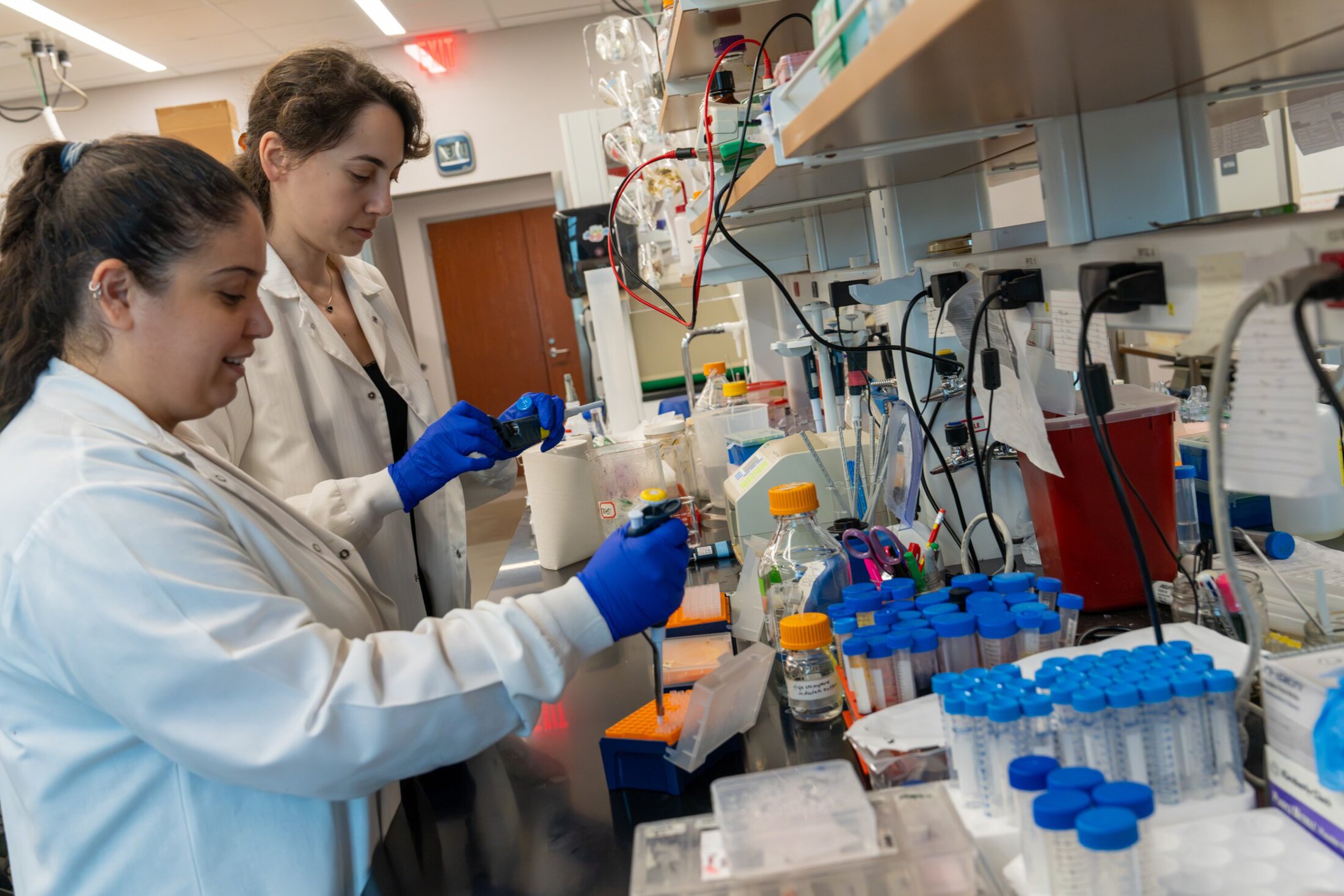
“LOX helps cancer cells keep multiple survival systems running. When we blocked LOX, the cancer cells lost that advantage,” explained postdoctoral fellow Burge Ulukan, Ph.D., the study’s co-first author. “When we inhibit it, we are inhibiting multiple arms. We’re disrupting cells’ energy production and making them much more vulnerable to treatment.”
Creating a weakness – then exploiting it
By disrupting multiple systems that cancer cells depend on, the researchers had left them vulnerable. The next question was how to capitalize on that weakness.
The researchers realized they could do that by triggering ferroptosis, a form of cell death caused by toxic damage inside the cell. Scientists are increasingly interested in harnessing ferroptosis to destroy cancer cells that resist other treatments.
Cancer cells have built-in defenses that protect them from ferroptosis. Blocking LOX weakened two of those defenses.
But the cancer cells did not give up. Instead, they relied more heavily on a backup defense controlled by a protein called DHODH. That helped the cells to survive after LOX was blocked – but it also created a new weakness as the cancer cells became increasingly dependent on DHODH.
The researchers saw an opportunity. If blocking LOX was the first punch, blocking DHODH could provide the second.
In laboratory experiments, blocking both pathways overwhelmed the cancer cells and caused damaging molecules to build up until the cells underwent ferroptosis.
The team then tested the strategy in several preclinical models, including models developed from patients whose tumors had become resistant to chemotherapy. They paired an experimental drug they developed to block LOX with leflunomide, a drug already approved by the U.S. Food and Drug Administration (FDA). Leflunomide works by blocking the backup defense that cancer cells had become dependent on.
The combination significantly blocked tumor growth across multiple patient-derived models. It did so without causing major weight loss or signs of kidney or liver toxicity. It also outperformed a combination of the LOX inhibitor and a standard chemotherapy drug.
“One of the most exciting aspects of this work is that we uncovered an entirely new role for LOX inside cancer cells,” said co-first author and postdoctoral fellow Ozge Saatci, Ph.D. “That discovery revealed a weakness we could exploit. Rather than attacking cancer cells from just one direction, we first weaken the cells and then target the backup system they rely on to survive. That opens the door to a new treatment strategy.”
One of the most exciting aspects of this work is that we uncovered an entirely new role for LOX inside cancer cells.
The findings are still preclinical and do not mean the combination is ready for patients yet. But use of an existing drug could potentially make that path toward clinical testing far easier.
“The good thing is when the drug is FDA approved, you know the side effect profile,” Sahin said. “It makes it faster and potentially safer to repurpose it, in other words, adapt it for a different disease condition.”
A potential path beyond chemotherapy
For patients, one of the most promising aspects of the research is the possibility of one day reducing reliance on chemotherapy. Although chemotherapy can be highly effective, it can also cause serious side effects, including heart damage and nerve damage that leads to numbness, tingling or pain in hands and feet. A successful nonchemotherapy approach could potentially avoid some of those toxicities. However, more research is needed to determine whether the new strategy is safe and effective in people.
Importantly, the researchers found evidence that the same biology they observed in the laboratory may also be at work in patients.
In tumor samples from people with TNBC, higher levels of LOX were linked to increased activity in the same energy and survival pathways identified in the study. Patients whose tumors had high levels of both LOX and DHODH also had poorer survival. Together, the findings raise the possibility that these proteins could eventually serve as biomarkers, helping to identify patients most likely to benefit from treatments targeting this vulnerability.
“LOX may act as a biomarker of response or resistance to the metabolic targeting of the tumors,” Ulukan said. “If we can identify patients whose tumors depend on this pathway, those may be the patients who benefit most from this type of treatment.”
Moving toward the clinic
The team is already developing a newer version of its LOX-blocking drug in collaboration with the University of South Carolina. The next step is completing the studies needed to test the drug safely in humans.
Sahin hopes that process can be completed within the next few years. An earlier goal is to determine whether the strategy can help patients whose cancers have stopped responding to current treatments.
LOX may act as a biomarker of response or resistance to the metabolic targeting of the tumors. If we can identify patients whose tumors depend on this pathway, those may be the patients who benefit most from this type of treatment.
This National Cancer Institute-funded work brought together researchers from across MUSC and Hollings as well as collaborators at other institutions, reflecting the multidisciplinary effort required to move discoveries from the laboratory toward the clinic.
For the researchers, the study represents more than the discovery of a new drug target. It offers a new way to think about how to outsmart one of cancer’s greatest strengths: its ability to adapt. That approach could prove especially valuable for aggressive cancers like TNBC, where treatment resistance remains one of the biggest barriers to long-term success.
Featured in this story

Ozgur Sahin, Ph.D.
Ozgur Sahin, Ph.D., is a professor and endowed chair in Lipidomics, Pathobiology and Therapy in the Department of Biochemistry & Molecular Biology and Hollings Cancer Center at the Medical University of South Carolina (MUSC). Furthermore, I am an American Cancer Society (ACS) Research Scholar; founder, and president of LoxiGen, Inc.; and co-founder, and manager of OncoCube Therapeutics, LLC. My laboratory focuses on elucidating the mechanisms of cancer therapeutics, drug resistance and metastasis, mainly in breast cancer. We combine our expertise in cancer cell biology, functional transcriptomics/bioinformatics, and drug discovery, with those of the experts from the medicinal chemistry, proteomics, and medical oncology fields to target the most aggressive cancers.
Reference
Ozge Saatci, Burge Ulukan, Metin Cetin, Hellen Kuasne, Constanza Martinez, Elif Percin, Natalia Oleinik, Matthew T. Savoca, Ali Nehme, Aldo Hernández-Corchado, Evelyn Zavacky, Kukkamudi Sreenivas, Abdol H. Rezaeian, Jennifer R. Bethard, Jean-Sebastien Anoma, Ozlem Sener Sahin, Adriana Aguilar-Mahecha, Marguerite Buchanan, Mertkaya Aras, Genevieve DeBlois, Mark Basik, Elizabeth G. Hill, Lauren E. Ball, Chintada Nageswara Rao, Campbell McInnes, Yasser Riazalhosseini, Hamed S. Najafabadi, John J. Lemasters, Besim Ogretmen, Morag Park and Ozgur Sahin. Lysyl oxidase inhibition disrupts mitochondrial homeostasis to create vulnerability to ferroptosis in TNBC. Cell Reports Medicine [31 August 2026]. doi: 10.1016/j.xcrm.2026.103015.
Grants from the National Cancer Institute (R01CA267101; R01CA251374; P30CA060553; P30CA138313) and the National Institute of Dental and Craniofacial Research (R01DE016572) supported this research. Additional funding came from the SmartState Endowment in Lipidomics and Drug Discovery Postdoctoral Fellowship at MUSC Hollings Cancer Center.

Hayley Kamin
Communications Manager
Hayley Kamin is the communications manager for the Hollings Cancer Center Communications and Marketing team, having joined the team in 2025 after three years as a communications specialist at the National Institutes of Health (NIH). As a science communicator with a Ph.D. from the University of Florida, she has extensive experience translating complex research into clear, engaging content. Her career has included roles at the NIH’s National Institute of Mental Health and the American Psychological Association, where she led content development and editorial strategy, developed science and health communications and worked with researchers and clinicians to strengthen public understanding of research.
Contact Hayley at kamin@musc.edu.
Recent Breast Cancer Research stories