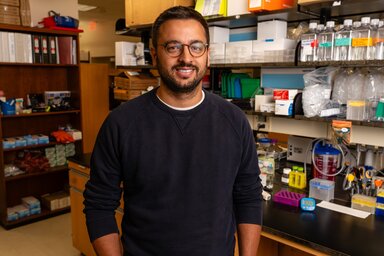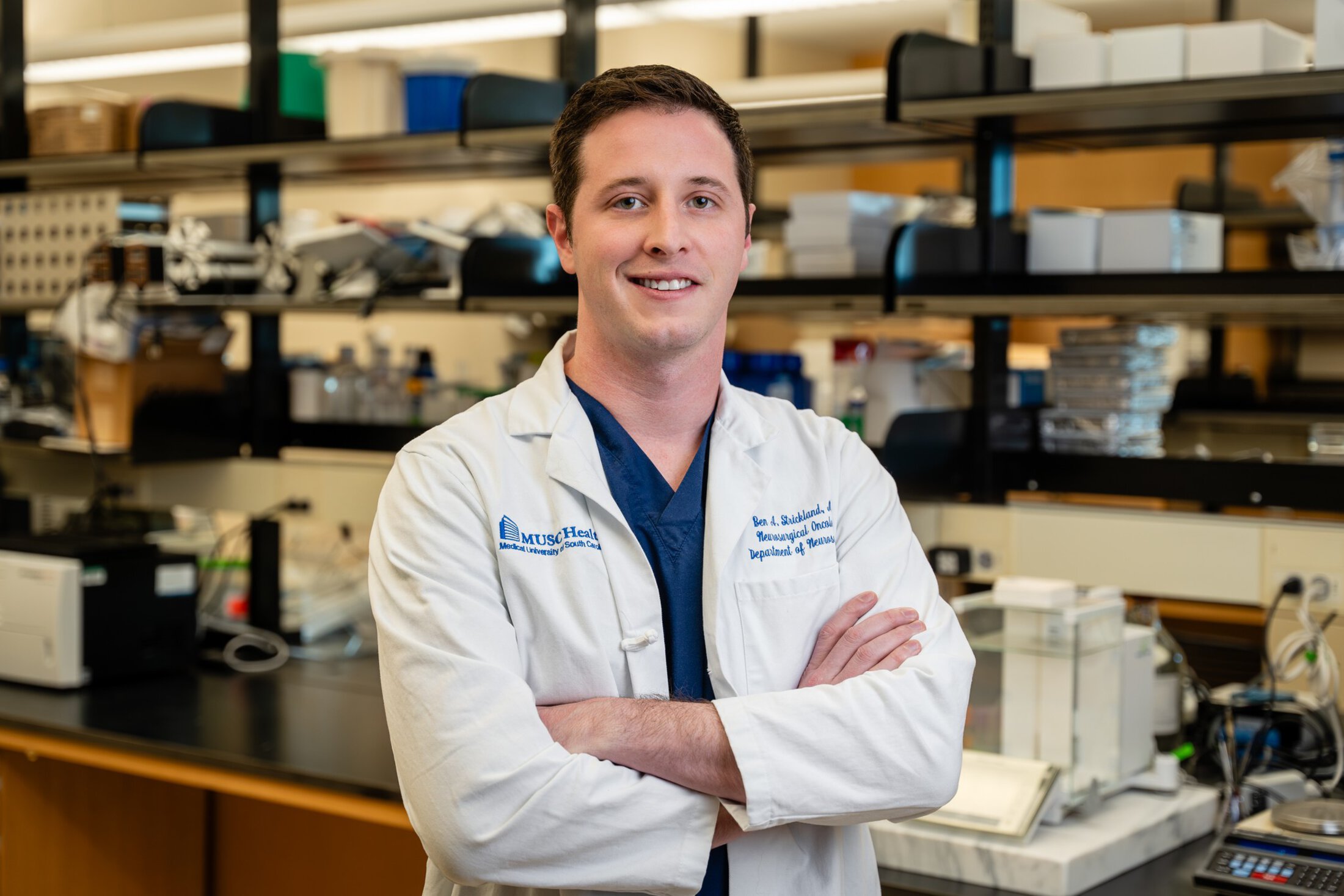
A new grant from the American Cancer Society (ACS) will fund research into a new strategy for targeting glioblastoma at MUSC Hollings Cancer Center. Glioblastoma is an aggressive type of brain cancer. Survival rates are low, and new treatments are rare – the most recent major breakthrough happened back in 2005, said Ben Strickland, M.D., a neurosurgeon who also runs a research lab at Hollings.
He’s just received the American Cancer Society’s Clinician Scientist Development Grant. This five-year grant is intended to develop the next generation of clinician scientists, people who keep one foot in the clinical world, treating and caring for patients, and the other in the research world, looking for new answers for those patients.
Strickland’s project seeks to develop an immunotherapy for glioblastoma that will make use of an underutilized player in the immune system – macrophages.
Immunotherapy for glioblastoma
Immunotherapy has transformed care for many cancers. Although the specifics are different for each treatment, the general idea is to bolster the body’s immune system so it does a better job of attacking cancer cells.
But immunotherapy has not worked on glioblastoma.
“It has categorically failed in glioblastoma so far,” Strickland said. “They've done a lot of really big trials for checkpoint inhibitors and CAR-T cell therapy and all these other adjuvant treatments, and it fails time and time again.”
Many of the successful immunotherapies for other cancers make use of T-cells. T-cells are part of the adaptive immune system, with each T-cell adapted to recognize a specific target, like one strain of the flu or COVID virus. T-cells are used in CAR-T cell therapy, where they’re engineered to recognize specific cancer cells.
There aren’t a lot of T-cells around glioblastomas, though. Instead, there are a lot of macrophages – in fact, maybe half of the cells in and around a glioblastoma are macrophages.
Macrophages are part of the innate immune system – the first line of defense against invaders. They’re not targeted toward specific viruses or bacteria; instead, they gobble up any cells that register as foreign as well as bits of cellular debris that need to be cleaned up.
Importantly, macrophages can toggle back and forth between job functions – they can be anti-inflammatory or pro-inflammatory. When macrophages are in pro-inflammatory mode, they’re calling in immune system reinforcements to attack the cancer. The glioblastoma cells can deal with that – they can send signals to the macrophages to go into anti-inflammatory mode. This helps the cancer because it means the immune system isn’t coming to the rescue; instead, the macrophages are helping the tumor to grow.
Strickland proposes to reprogram the macrophages so they go into pro-inflammatory mode. In his work so far, not only does the macrophage go from pro-tumor to anti-tumor, but it also helps to wake up the T-cells.
Benefiting from multidisciplinary mentorship
An important part of this ACS grant is the mentorship and professional development component. The grant isn’t solely about this one research project but about launching a whole career full of research projects.
Strickland is being mentored by a team with great breadth: MUSC researcher Stephen Tomlinson, Ph.D., who studies the complement system; Hollings researcher Ozgur Sahin, Ph.D., who has expertise in immunotherapy and drug discovery; and University of Colorado Anschutz neurosurgeon and researcher Peter Fecci, M.D., Ph.D.
Fecci is a glioblastoma surgeon who studies T-cell immunosuppression. In a recent paper, he described how macrophages are the main drivers of immunosuppression in glioblastoma because they prevent T-cells from entering the tumor and, if T-cells do manage to enter, the macrophages immediately exhaust them.
Once we reprogram the macrophage to be the good kind, the macrophage then goes on to increase T-cell killer status.
That paper was fresh in his mind when he and Strickland met, Strickland noted, and Strickland had already begun working on his idea.
“And I also just happened to have a lot of the preliminary data coming here that would support launching a study. So it was just fortuitous timing for both of us,” he said.
Tomlinson is the “complement world guru,” Strickland said. The complement system is part of the immune system. Strickland will target C5A R1, a receptor on macrophages. By blocking this receptor, the macrophages will change their behavior to become anti-tumor.
“And the downstream ramifications of that are, once we reprogram the macrophage to be the good kind, the macrophage then goes on to increase T-cell killer status. So there's an indirect boost on the T-cells,” Strickland said.
Testing real-world reactions
Strickland has already seen the macrophages reverse course in preclinical testing in his lab.
The next step is to see how well this works in active cancer cases and whether reprogramming the macrophages to be pro-inflammatory then clears the way for existing immunotherapies to work.
Strickland anticipates moving into human studies by the end of the year. The initial study will look at whether what’s been observed in the lab will also occur in real-world situations.
Everyone in the study will receive the standard treatment for glioblastoma, which includes surgery, radiation and chemotherapy.
The difference is they’ll also receive the study drug to reprogram the macrophages, and then a checkpoint inhibitor – a type of immunotherapy that has been hugely successful in other types of cancer. After Strickland removes each patient’s tumor in the operating room, his lab will examine the tumor to see if the checkpoint inhibitor is active.
“We know the drug's safe,” Strickland explained. “We know the drug gets to the tumor. We've got a whole bunch of in vitro data with human glioblastoma samples that I've taken out, and we've studied in the lab, and we've done a whole bunch of mice studies. So now we're going to be pretreating glioblastoma patients with the drug, and then we'll be taking the tumor out and ensuring that it's doing what we expect it to do.”
These initial human studies are meant to test whether the mechanism works as expected, but they don't test whether it adds a treatment benefit for patients. That's what clinical trials do.
If all goes well, Strickland hopes to launch clinical trials by the end of his five-year grant period.
Featured in this story
Ben Strickland, M.D.
I am a neurosurgeon-scientist with a keen interest in the molecular underpinnings responsible for the malignant transformation of meningioma. My goal is to synergize my clinical practice with laboratory investigations towards the development of precise immunotherapies to combat this highly prevalent, yet understudied tumor.
Stephen Tomlinson, Ph.D.
Stephen Tomlinson, Ph.D., is a professor of the Department of Pharmacology & Immunology in the College of Medicine at the Medical University of South Carolina (MUSC). He also has served in academic leadership roles focused on research strategy and faculty development. Dr. Tomlinson received his undergraduate training at the University of Leeds and earned his Doctor of Philosophy (Ph.D.) in from the University of Cambridge, followed by postdoctoral training at the University of Florida. He joined the MUSC faculty in 2000.
Dr. Tomlinson’s research centers on the complement system and its role in inflammation, tissue injury, and immune mediated disease. His work spans neuroinflammation, ischemic and traumatic brain injury, transplantation, autoimmunity, and cancer, with a strong emphasis on translational science. His laboratory is recognized for developing site targeted complement inhibitors designed to suppress harmful complement activation at sites of injury while preserving systemic immune function. His research has resulted in numerous peer reviewed publications, patents, and technologies advancing toward clinical application.
In addition to his research program, Dr. Tomlinson is actively involved in mentoring trainees and junior faculty and contributes to interdisciplinary collaborations across MUSC’s research enterprise.
Focus: The complement system in inflammation, alloimmunity, cancer immunity and CNS injury.
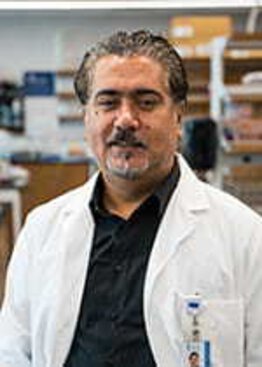
Ozgur Sahin, Ph.D.
Ozgur Sahin, Ph.D., is a professor and endowed chair in Lipidomics, Pathobiology and Therapy in the Department of Biochemistry & Molecular Biology and Hollings Cancer Center at the Medical University of South Carolina (MUSC). Furthermore, I am an American Cancer Society (ACS) Research Scholar; founder, and president of LoxiGen, Inc.; and co-founder, and manager of OncoCube Therapeutics, LLC. My laboratory focuses on elucidating the mechanisms of cancer therapeutics, drug resistance and metastasis, mainly in breast cancer. We combine our expertise in cancer cell biology, functional transcriptomics/bioinformatics, and drug discovery, with those of the experts from the medicinal chemistry, proteomics, and medical oncology fields to target the most aggressive cancers.
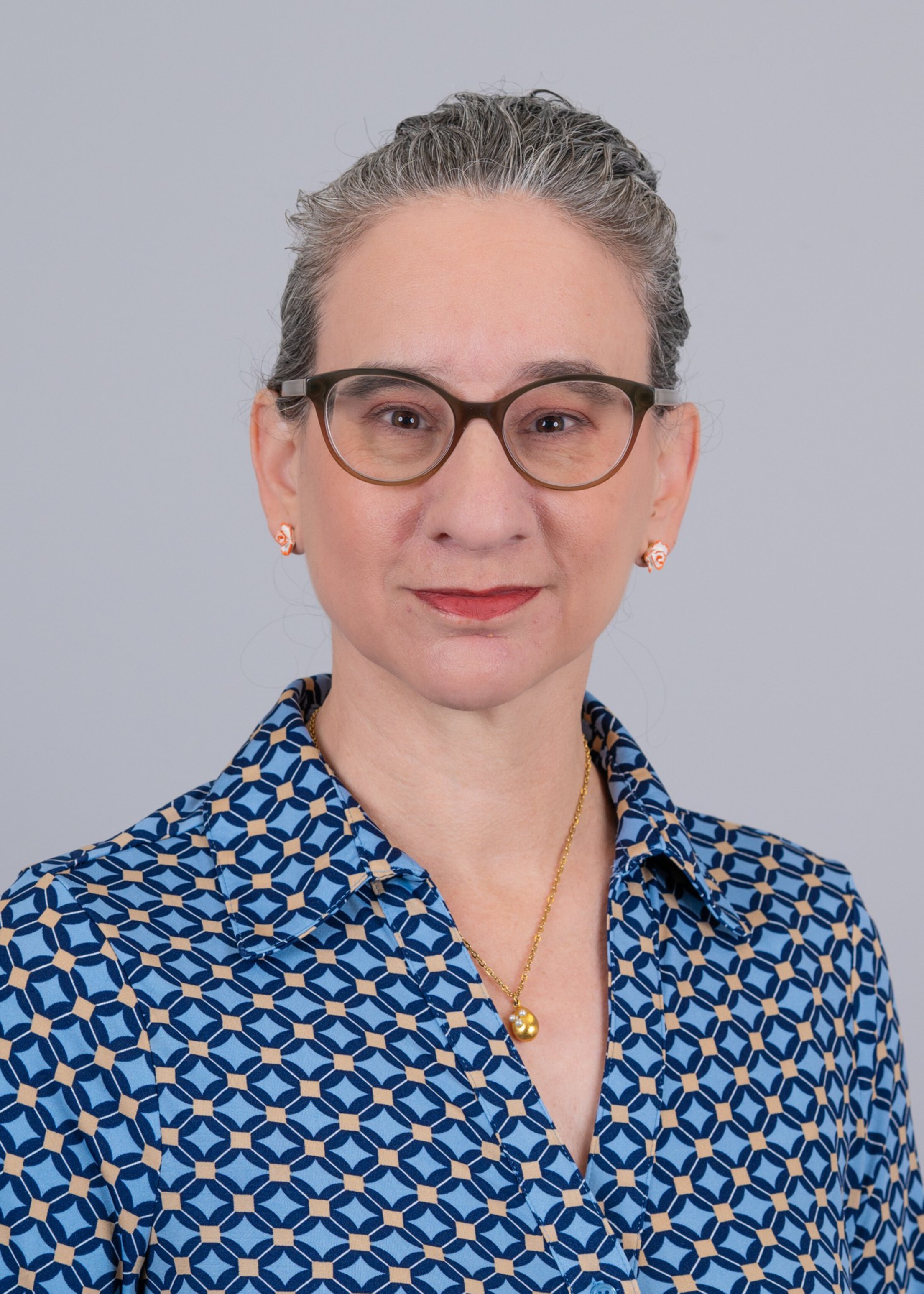
Leslie Cantu
Senior Communications Manager
Leslie Cantu is the senior communications manager at MUSC Hollings Cancer Center, where she works with researchers, clinicians and patients to tell the people of South Carolina about the innovative work being done to improve cancer care for everyone in the state. She joined the MUSC Office of Communications and Marketing in 2018 after a career as an award-winning writer, editor and producer at community newspapers and local TV news. She transferred to the communications office at Hollings in 2022, where she happily finds something new and interesting to write about every day. Her favorite stories to cover at MUSC have included Match Day, the Angel Tree Parade, a clinical trial of CAR-T cell therapy and the many patients who have agreed to share their very personal struggles and triumphs.
Contact Leslie at cantul@musc.edu.
Recent Cancer Research stories