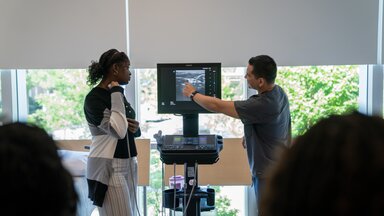
Many undergraduate students, like Reid Barker at the College of Charleston, need to squeeze in research between classes or after work. This summer, she has both the time and support to make it her focus, thanks to a grant from the St. Baldrick’s Foundation.
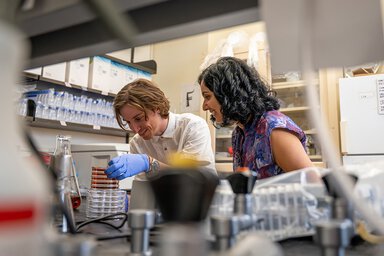
As a research fellow at MUSC Hollings Cancer Center, the rising senior will spend her summer in the lab of Casey Langdon, Ph.D., who has a dual appointment at Hollings and the Darby Children’s Research Institute at MUSC.
That shift – from fitting in research to focusing on it full time – is exactly what the St. Baldrick’s Summer Fellows Grant is designed to make possible. The fellowship gives Barker the chance to work full time in the lab and take ownership of a project that could one day shape how pediatric cancers are treated.
Making time for deeper work
Barker joined Langdon’s lab during her sophomore year, initially to meet honors requirements and gain research experience for medical school. But she soon gained a deep appreciation for the research itself as her passion for science grew.
Even though, at first, much of the work felt difficult to follow.
“I remember sitting in lab meetings and not really knowing what was going on,” she admitted.
Over time, that changed. Through hands-on work and close mentorship, she started to understand how experiments connect, how results are interpreted and how research moves forward.

“Now I’m connecting the dots – understanding why we do certain experiments and what the results mean. Even reading scientific papers makes much more sense,” she said.
Her first summer in the lab was spent learning the basics, observing, assisting and building foundational skills. This summer marks a transition to leading the work she once observed.
“This year, she’s cooking,” Langdon said with a laugh. “She was watching before. Now she’s running experiments.”
The goal, he said, is not just to teach techniques but to help students to think like scientists – able to ask questions, interpret data and communicate findings. That growth is already showing. Barker co-presented research at a statewide research symposium this spring and continues to contribute to abstracts and scientific writing.
“She’s not just learning the science,” Langdon said. “She’s learning how to communicate it and how to help others learn it, too.”
He points to her ability to write clearly about complex topics as a clear sign of her progress.
“She has a very good grasp of the science,” he added. “And, importantly, can share it. Her writing and ability to synthesize research, that’s something you usually see much further along.”
Supporting the work and the pipeline behind it
For labs like Langdon’s, funding from St. Baldrick’s supports more than individual experiments. It supports the structure that allows research – and researchers – to develop.
“It gives us the opportunity to make discoveries and to train students like Reid,” Langdon said. “That support, both financial and knowing people believe in your work, means everything.”
That kind of support is especially important in pediatric cancer research, where progress has historically lagged behind adult oncology.
Langdon and Barker’s work focuses on pediatric sarcomas, including Ewing sarcoma, a rare bone cancer diagnosed in about 250 children in the U.S. each year. Despite decades of research, treatment options have changed little.
“There haven’t been any new types of therapies for Ewing sarcoma since 2003 to improve survival; we are still using the same types of chemotherapies to treat these kids,” Langdon said. “In some related childhood cancers, it’s been even longer – up to 40 to 50 years.”
It gives us the opportunity to make discoveries and to train students like Reid. That support, both financial and knowing people believe in your work, means everything.
Pediatric cancers are rare and biologically distinct, often driven by different genetic changes and offering fewer targets for treatment than adult cancers. Langdon’s lab is working to identify combinations of existing drugs that could offer more effective and tolerable options for young patients.
“Children aren’t just little adults,” Langdon explained. “You can’t take the same medications and simply reduce the dosage.”
Turning support into progress
Barker’s summer project focuses on testing one of those drug combinations using more advanced models.
Working with postdoctoral researcher Allison Reno, Ph.D., she will use a three-dimensional cell culture system designed to mimic how tumors grow in human bone tissue. Compared with traditional flat models, the 3-D system offers a closer representation of how cancer behaves in the body.
“These models are more representative of what we would see in a patient,” Langdon said.
She will also gain experience testing treatments in living systems under the guidance of graduate researcher Cameron Bumbleberg – an important step in moving research toward potential clinical applications in patients.
As her role in the lab has grown, Barker has also taken on a new one: guiding other students as they learn the foundational skills she once worked to master. That progression from learning to teaching is part of what fellowships like this support.
“These programs aren’t just about the science,” Langdon said. “They’re also about training the next generation of scientists.”
For Barker, the impact has been tangible.
“I’m excited to be in the driver’s seat,” she said. “I really enjoy coming to the lab. I like doing the experiments. I like learning.”
The research itself is still in early stages, with the long-term goal of moving findings toward clinical trials and, ultimately, better treatment options for children with cancer.
“We’re trying to make a real difference for these kids,” Langdon said. “They deserve it. Their families deserve it.”
For now, support from the St. Baldrick’s Foundation is driving progress in the lab while supporting the next generation of scientists behind it.
Featured in this story

Casey Langdon, Ph.D.
I am a member of the Darby Children’s Research Institute and Hollings Cancer Center at the Medical University of South Carolina. My research is focused on determining how tumor suppressor functions are disrupted in cancer by dysregulated subcellular localization. I have a broad cancer biology background in both adult and pediatric cancers. My laboratory studies Ewing sarcoma (EwS), a genetically simple but devastating pediatric bone cancer with poor prognoses and outcomes.
Hayley Kamin
Communications Manager
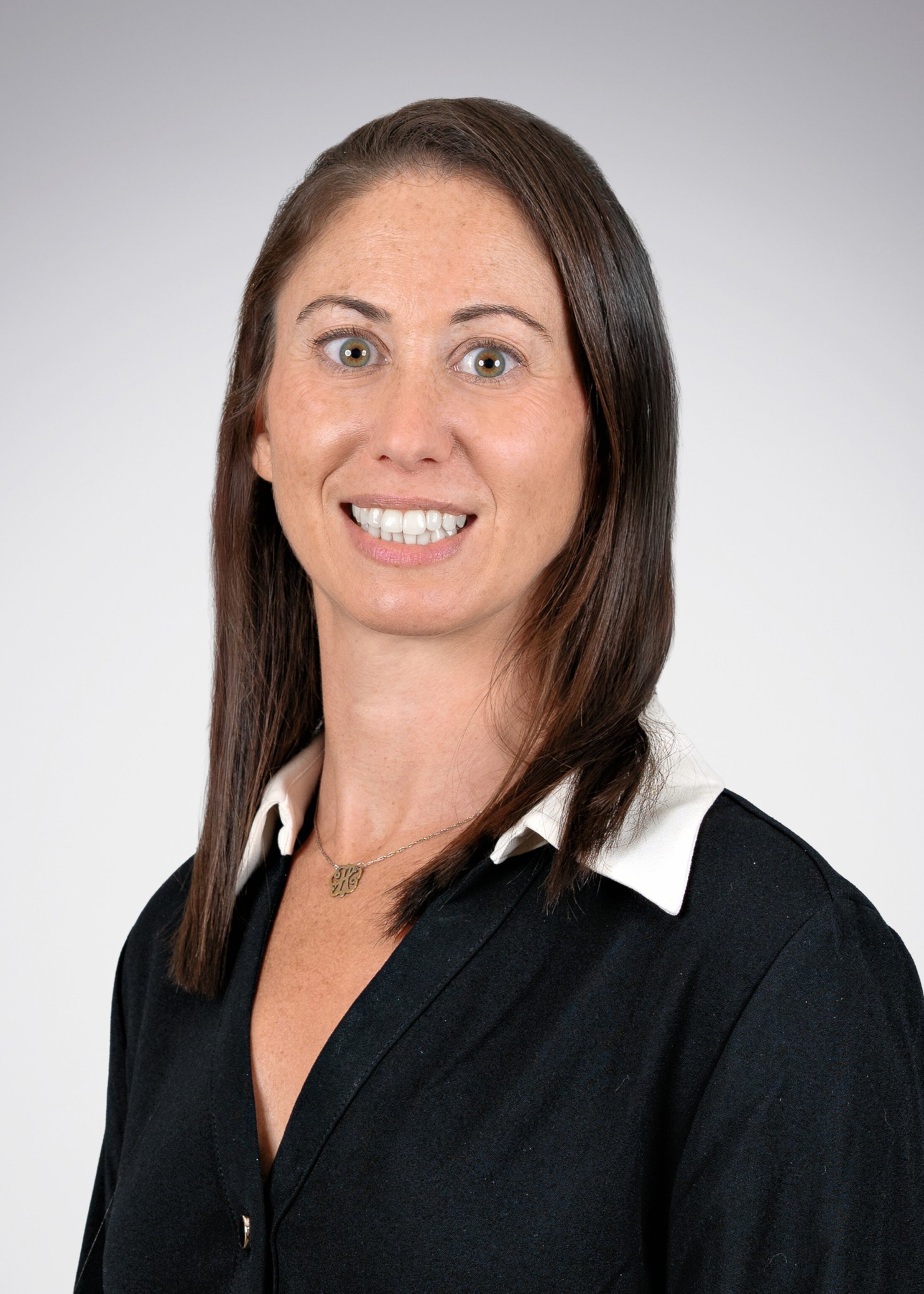
Hayley Kamin is the communications manager for the Hollings Cancer Center Communications and Marketing team, having joined the team in 2025 after three years as a communications specialist at the National Institutes of Health (NIH). As a science communicator with a Ph.D. from the University of Florida, she has extensive experience translating complex research into clear, engaging content. Her career has included roles at the NIH’s National Institute of Mental Health and the American Psychological Association, where she led content development and editorial strategy, developed science and health communications and worked with researchers and clinicians to strengthen public understanding of research.
Contact Hayley at kamin@musc.edu.
Recent Cancer Education and Training stories