Even as biomarker testing has become increasingly important to selecting the right lung cancer treatment, the time it takes to order these tests hasn’t improved.
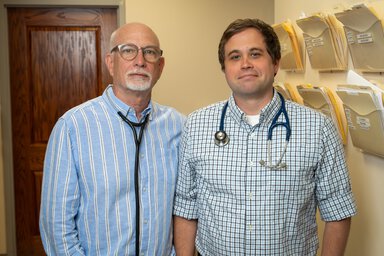
Overall, the time from biopsy to biomarker results is about twice as long as most doctors think it is. And that wait can affect whether patients get started on the correct first-line treatment to match their cancer, such as a targeted therapy or immunotherapy. A mismatched therapy might not work or could lead to complications, said lung cancer pulmonologist Adam Fox, M.D., who led the research. The work was supported, in part, by the American Cancer Society National Lung Cancer Roundtable. The results were published in JCO Oncology Practice.
Fox, who treats patients and conducts research at MUSC Hollings Cancer Center, worked with fellow Hollings pulmonologist Gerard Silvestri, M.D., and a biomarker testing company to assess testing turnaround times for multiple types of solid tumors between 2018 and 2024. Much of their focus was on non-small cell lung cancer, because selecting the correct treatment has increasingly become so important in lung cancer care.
“In lung cancer, in an ideal world, you would prefer to have this testing before any treatment is given to most patients – surgery, chemo, any systemic therapy, radiation – you'd really prefer to have this as soon as possible,” Fox said. “You want to get it right the first time. That’s what I tell patients. You want to get the right treatment delivered first but still as efficiently as possible.”
The research team looked at the overall turnaround time and then broke the process down into segments:
- How long it takes to order testing after a biopsy.
- How long it takes to package and ship the sample to the testing company.
- How long it takes for the testing company to do the testing and report the results.
Overall time improved from 36 days to 27 days between 2018 and 2024 – but that improvement was almost entirely the result of improvements in testing time at the lab.
The first step – the time that it took to order the test – actually got a little worse: one more day than at the beginning of the study.
That is also the step that showed the most variability across sites. In 2024, for example, the median turnaround for this first step was eight days for the fastest 20% of sites. But for the slowest 20%, the median turnaround time was 23 days – just to order the test. And that, Fox emphasized, was the median. Some sites took as long as 30 days to order testing.
Most doctors aren’t aware of the overall turnaround time, probably because they’re seeing only part of the process.
I think this data, of four weeks on average, would shock a lot of people.
“A couple of years ago, we asked 400 pulmonologists, ‘How long does each of these steps take, from biopsy to referral to biomarker testing?’ And they estimated two weeks,” Fox said. “Maybe some of them are correct, and it takes about two weeks. But they would have to be in the highest-performing sites, because our median was more like four weeks. I think this data, of four weeks on average, would shock a lot of people.”
Biomarkers are specific biological indicators that give doctors information about a tumor. In lung cancer, they can tell doctors whether a specific drug treatment is likely to work – or not. In recent years, many targeted therapies have been developed that target specific genetic mutations. But these new drugs only work for people with those genetic mutations. On the other hand, immunotherapies that are otherwise widely used in lung cancer might not work for people with some genetic mutations.
It’s important to match the treatment to the individual cancer – but when people are facing a cancer diagnosis and a long wait for biomarker results, both doctors and patients might feel pressure to get some kind of treatment started, even if it later turns out to be a suboptimal treatment.
And it’s not just a matter of switching to the proper treatment once biomarker results are in.
“For instance, switching from immunotherapy to a targeted therapy has an increased risk of reactions like pneumonitis,” Fox said. Pneumonitis is a swelling and irritation of the lungs that can cause permanent problems like shortness of breath.
There’s also the chance that the initial treatment, which could have toxic side effects, could weaken the patient. Or, the patient could decide that the side effects are too much, and they don’t want to do any treatment, even if the doctor assures them that an alternative has fewer side effects. There’s also a chance that a treatment could make the patient ineligible for clinical trials later on.
Ordering biomarker testing immediately after a biopsy seems like the easy and obvious solution, but there are many historical and logistical factors that complicate the process, Fox said.
MUSC has implemented “reflex testing.” Pathologists reflexively initiate testing after they find lung cancer cells in a sample. But that’s not necessarily possible in every system.
He thinks there are a few systemic barriers that could be preventing reflex testing or similar programs.
Pathologists don't necessarily have the expertise to know which tests to order, he explained, especially as molecular testing continues to evolve. MUSC has an in-house lab, which makes it easier to set up a process, but most hospitals don’t.
Some doctors may still remember when insurance companies didn’t cover biomarker testing, and patients ended up with bills for thousands of dollars.
And a 14-day rule for inpatient testing for Medicare patients may inadvertently be prolonging the testing process. Some patients might be admitted to the hospital for pneumonia or other illnesses and then diagnosed with lung cancer while hospitalized. Biomarker testing is still needed for these patients to inform their outpatient cancer treatment once they’re referred to an oncologist, Fox said. But if the biomarker testing is ordered during that window, complex reimbursement rules may leave hospitals responsible for the costs rather than being reimbursed at the outpatient rate.
That’s a complicated, little-discussed issue that can have extensive ripple effects. It’s unclear how Medicare and private insurance reimbursement policies affect turnaround times on a national scale, but they certainly play a role, Fox noted.
Finally, there’s no clear directive stating who should order biomarker testing.
“If there’s no consensus or plan, then it might be kind of willy-nilly,” Fox said. “Whoever happens to order it, orders it, and often that is going to be the oncologist, the last person in line.”
Although the paper focuses on lung cancer, it also includes data on turnaround times for multiple types of solid tumors. Fox noted that biomarker testing might not be as critical for some other cancer types because it doesn’t determine the initial treatment that a patient receives. But it will probably continue to gain importance.
The turnaround time for shipping and lab testing was similar among the different cancer types – the big variation was in the time to order the test. While there was a median of 14 days in 2024 to order testing for non-small cell lung cancer, the median was 22 days for ovarian cancer and 27 days for other types of gynecologic cancer.
Fox said the big takeaway from this paper is that specialties should work together to order these tests as quickly as is efficiently possible.
“Time is of the essence, and this is a component of time,” he said. “And my argument is if it just takes a little bit of logistical work for many places to find a mechanism to order this weeks earlier, then we should put in the effort.”
In this story
Adam Fox, M.D., MSCR
Adam Fox, M.D., is a pulmonologist and clinician scientist with a research focus in health services research for patients with lung cancer at the Medical University of South Carolina (MUSC). His long-term research goal is to improve care delivery for patients newly diagnosed with lung cancer, especially as it relates to precision medicine therapies. His clinical time is spent evaluating patients suspected to have lung cancer in a multi-disciplinary thoracic oncology clinic, performing bronchoscopy for diagnostic or staging purposes, and collaborating on cases through our multi-disciplinary thoracic tumor board. Biomarker testing performed on patient's lung cancer tissue continues to grow in importance in driving precision medicine treatment decisions, especially as new therapies and indications emerge for both targeted and immune therapies.
He serves as co-principal investigator on a grant from the American Cancer Society (ACS) to assess biomarker testing and treatment patterns in nationally representative databases. He is the co-lead faculty for the ACS Extension for Community Health Outcomes (ECHO) for biomarker testing in South Carolina, and a member of the ACS National Lung Cancer Roundtable (NLCRT) Triage for Appropriate Treatment Task Group.

Gerard A. Silvestri, M.D., MS
I am a lung cancer pulmonologist with expertise in the evaluation, management, and improvement of outcomes of patients with lung cancer. I conduct patient-oriented clinical research studies that encompass nearly every aspect of lung cancer care, including lung cancer screening, disparities in cancer care, shared decision-making, and the evaluation and management of pulmonary nodules. I have a graduate degree in the evaluative clinical sciences, and I apply the health services research techniques I learned to many aspects of lung cancer care.
References
Adam H. Fox et al. Turnaround Time of Comprehensive Genomic Profiling in Lung Cancer and Other Solid Tumors. JCO Oncol Pract 0, OP-25-01191
DOI:10.1200/OP-25-01191
Supported by Foundation Medicine, Inc. This project was funded, in part, through a grant from the American Cancer Society National Lung Cancer Roundtable. Supported in part by Grant ID: CSDG-24-1252972-01-CTPS from the American Cancer Society.

Leslie Cantu
Senior Communications Manager
Leslie Cantu is the senior communications manager at MUSC Hollings Cancer Center, where she works with researchers, clinicians and patients to tell the people of South Carolina about the innovative work being done to improve cancer care for everyone in the state. She joined the MUSC Office of Communications and Marketing in 2018 after a career as an award-winning writer, editor and producer at community newspapers and local TV news. She transferred to the communications office at Hollings in 2022, where she happily finds something new and interesting to write about every day. Her favorite stories to cover at MUSC have included Match Day, the Angel Tree Parade, a clinical trial of CAR-T cell therapy and the many patients who have agreed to share their very personal struggles and triumphs.
Contact Leslie at cantul@musc.edu.
Recent Lung Cancer Research stories