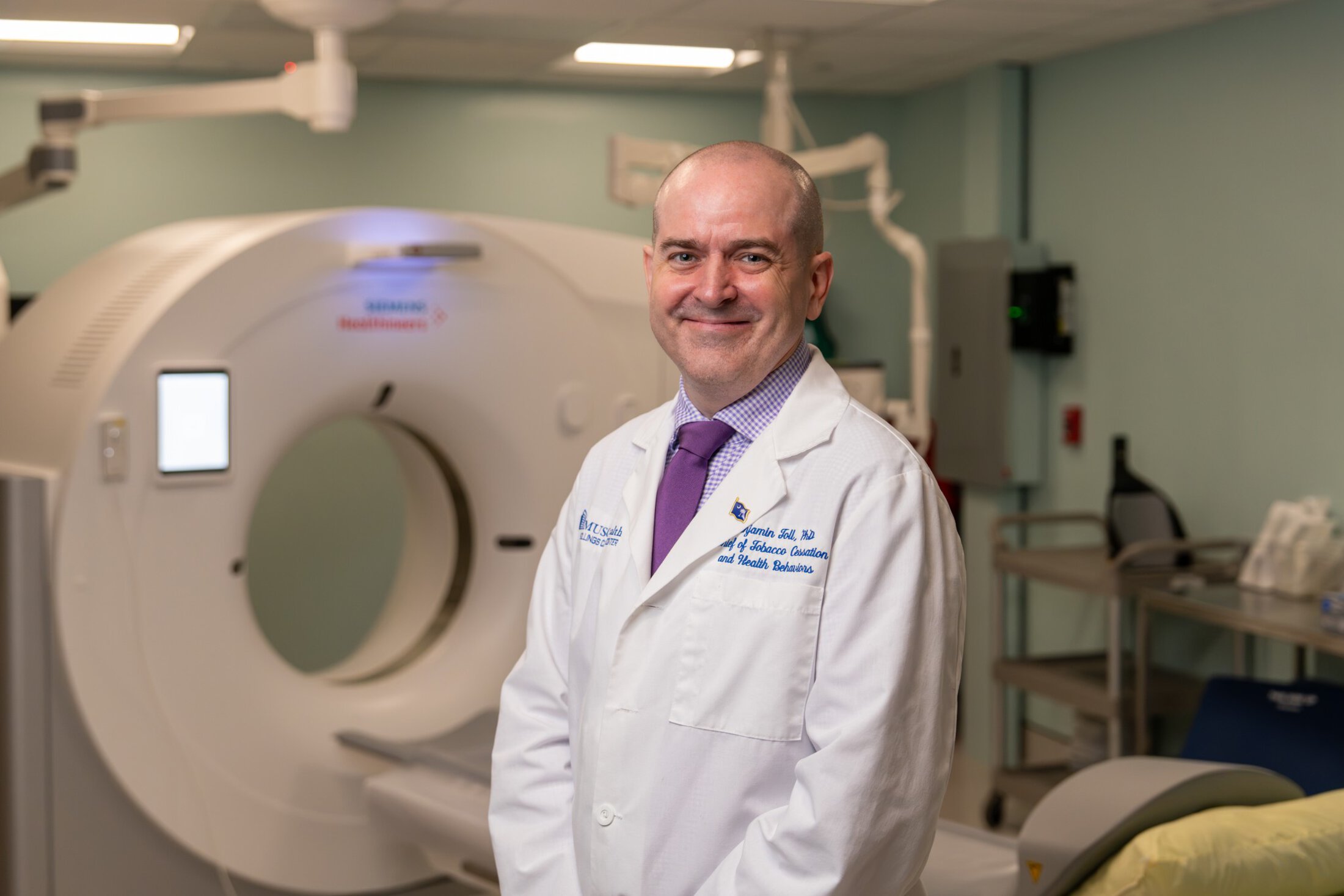
For many longtime smokers, lung cancer screening can be an uneasy experience. As they prepare for a scan to possibly detect lung cancer, they are often confronted with the health consequences of a habit they may have long struggled to quit. Researchers at MUSC Hollings Cancer Center wondered whether that screening appointment could also be an opportunity to encourage people to quit smoking.
In a new study published in the American Journal of Respiratory and Critical Care Medicine, MUSC researchers tested whether a simple intervention that combined nicotine replacement therapy with positive smoking cessation messages could help smokers to quit when paired with lung cancer screening. While the low-touch intervention did not significantly increase quit rates, the findings provide important lessons about how to deliver tobacco treatment in real-world healthcare settings.
"The larger goal is to figure out how we can enhance smoking cessation treatment," said Benjamin Toll, Ph.D., co-director of the Lung Cancer Screening Program and director of the Tobacco Treatment Program at MUSC Health. "We know that when people quit smoking, we can substantially improve the lifesaving benefits of lung cancer screening."
More than a screening test
Lung cancer screening uses a low-dose CT scan to detect cancer. It can find cancer at an earlier, more treatable stage – but only if people get scanned. The screening is recommended for people at high risk for lung cancer: typically, adults ages 50 to 80 who currently smoke or have quit within the past 15 years and have a 20-pack-year history of smoking – the equivalent of one pack per day for 20 years or two packs per day for 10 years.
Researchers often refer to the screening as a "teachable moment" because patients may be especially receptive to conversations about smoking and health. While early detection through screening alone reduces lung cancer mortality by about 20%, research shows that combining it with smoking cessation treatment almost doubles that benefit to a 38% reduction in lung cancer mortality.
“For patients undergoing lung cancer screening, tobacco treatment is an important complement,” Toll said. "By finding cancer earlier, the screening itself saves lives. But if you help someone quit smoking at the same time, the impact becomes even greater. It reduces the risk of developing lung cancer in the first place and improves overall health. When we combine those approaches, that's where we see the greatest benefit."
We know tobacco dependence is a chronic condition, not simply a matter of willpower. Many people have tried to quit multiple times before they're successful. The key is making sure they have access to effective treatments and supports.
However, many lung cancer screening programs lack the resources, staffing and infrastructure to provide comprehensive tobacco treatment services. That reality prompted Toll and colleagues to ask whether a simple, low-cost intervention could make a difference.
"We wanted to see whether a very low-touch intervention could move the needle," Toll said. "Could we provide something that's inexpensive, easy to implement and scalable across screening programs?"
Testing a simple approach
This study was part of the Smoking Cessation at Lung Examination (SCALE) Collaboration, a nationwide effort examining ways to integrate tobacco treatment into lung cancer screening programs.
The trial enrolled 308 adults who currently smoke and were undergoing lung cancer screening at MUSC and Yale University. Motivation to quit smoking was not required for enrollment, although average motivation levels were moderate to high.
The researchers used a technique called “gain-framed messaging.” Rather than focusing on the dangers of smoking, gain-framed messages emphasize what people stand to gain by quitting, such as improved health, lower cancer risk, better breathing and more years with family and loved ones. The approach is based on prospect theory, a Nobel Prize-winning framework that suggests people are often more receptive to messages emphasizing the positive outcomes of low-risk behaviors rather than the negative consequences.
"For smoking cessation, quitting is really all benefits," Toll said. "Research has shown that emphasizing those benefits can be a helpful way to motivate people to stop smoking."
Participants were randomly assigned to one of two interventions.
- One group received a two-week starter pack of nicotine replacement therapy, including patches and lozenges, along with a brief educational video and printed materials using the gain-framed messaging.
- The comparison group received standard smoking cessation materials that did not use this messaging and no nicotine replacement therapy.
Modest results, important lessons
At six months, 10.5% of participants who received the nicotine replacement starter packs and gain-framed materials had quit smoking, compared with 7.9% of participants in the comparison group. Although the quit rate was higher in the intervention group, the difference was not statistically significant.
The researchers also found a difference between men and women. The intervention was significantly more effective for men, without a similar benefit for women.
Toll noted that the results should be viewed in the context of the screening population.
"These are people who are typically over age 50 and have long histories of smoking," he said. "We're talking about a population for whom quitting can be especially challenging."
The study also suggested that the intervention was practical to deliver in clinical settings. Nearly half of participants who received the starter packs reported using the nicotine replacement products during the first months after enrollment, demonstrating that the approach was acceptable and feasible to many smokers.
Finding the right balance
Looking back, Toll believes the intervention may simply have been too light – but it provided valuable information about what may be needed to help smokers to quit.
"I'm glad we did the study because we learned quite a bit," he said. "But if I were designing it again, I would make it somewhat more intensive."
Toll also said the findings reinforce a sobering reality: Quitting smoking often requires multiple attempts and ongoing support.
"We know tobacco dependence is a chronic condition, not simply a matter of willpower. Many people have tried to quit multiple times before they're successful. The key is making sure they have access to effective treatments and supports."
While researchers continue searching for scalable approaches that can be incorporated into screening programs, patients at Hollings already have access to comprehensive support through the MUSC Health Tobacco Treatment Program. The program offers personalized treatment plans that can include counseling, nicotine replacement therapy and prescription medications to help patients to manage cravings and withdrawal symptoms.
Future research will focus on identifying medium-touch approaches that are practical enough to deploy widely while still providing meaningful support for people trying to quit.
"We need approaches that are both effective and realistic – finding that sweet spot where interventions are strong enough to help people quit but simple enough to be delivered broadly," Toll said. "If we can help people quit smoking at the same time that they get screened, we can not only find cancer sooner but prevent future cancers altogether."
Getting help to quit

Tobacco Treatment
Featured in this story

Benjamin Toll, Ph.D.
Benjamin Toll, Ph.D., a professor of public health sciences and psychiatry at MUSC, specializes in the treatment of tobacco use disorders and improvement of health behaviors. As associate director, his goal is to provide well-structured and effective education and training opportunities for pre- and post-doctoral students and junior faculty at Hollings Cancer Center.
Reference
Lisa M. Fucito, Alana M. Rojewski, Lynn Tanoue, Steven L. Bernstein, Nathaniel L. Baker, Nichole Tanner, Matthew J. Carpenter, K. Michael Cummings, Gerard Silvestri and Benjamin A. Toll. Nicotine replacement therapy starter packs and gain-framed messages to promote smoking cessation in lung cancer screening: A randomized trial. American Journal of Respiratory and Critical Care Medicine [June 2026]. doi: 10.1093/ajrccm/aamag188.
Grants from the National Cancer Institute (R01CA207229; P30CA138313; P30CA016359; P50CA196530) supported this research.

Hayley Kamin
Communications Manager
Hayley Kamin is the communications manager for the Hollings Cancer Center Communications and Marketing team, having joined the team in 2025 after three years as a communications specialist at the National Institutes of Health (NIH). As a science communicator with a Ph.D. from the University of Florida, she has extensive experience translating complex research into clear, engaging content. Her career has included roles at the NIH’s National Institute of Mental Health and the American Psychological Association, where she led content development and editorial strategy, developed science and health communications and worked with researchers and clinicians to strengthen public understanding of research.
Contact Hayley at kamin@musc.edu.
Recent Tobacco Control stories