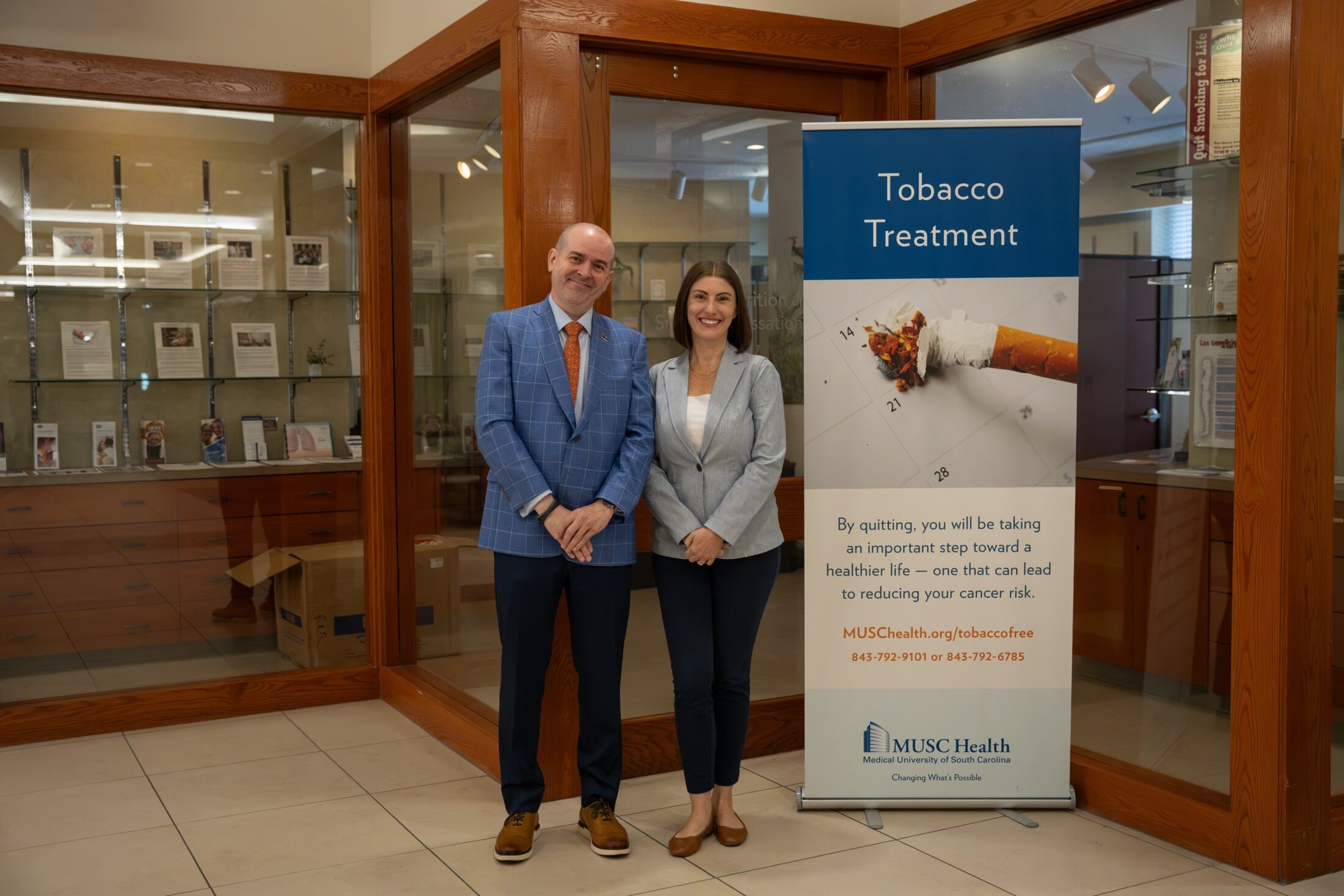
For people who smoke cigarettes, a hospital stay may be an opportunity to quit. New clinical guidelines developed with experts from MUSC Hollings Cancer Center call on hospitals to make tobacco treatment a routine part of care.
The guidelines from the American College of Chest Physicians, or CHEST, recommend an “opt-out” approach: Every hospitalized patient who currently smokes should be proactively offered tobacco treatment. That marks a shift from approaches that offer treatment primarily to patients who say they are ready to quit.
The goal is to keep tobacco use from getting lost among the many other health concerns being addressed during a hospitalization, said Benjamin Toll, Ph.D., director of the MUSC Health Tobacco Treatment Program and co-director of the Lung Cancer Screening Program. Toll helped to develop the guidelines along with Alana Rojewski, Ph.D., associate director of the Tobacco Treatment Program.
“Unfortunately, but understandably, tobacco can get overlooked,” Toll said. “Our providers are so busy clinically. There’s a lot to do.”
But a hospital stay can be an important window for intervention. Patients cannot smoke while there, meaning those who regularly smoke may experience nicotine withdrawal. That gives providers an opportunity to treat those symptoms while also opening a conversation about whether the patient might want to stop smoking for good.
“It’s important just to have the conversation,” Toll emphasized.
Grounding the guidelines in evidence
The recommendations are based on an extensive review of the scientific literature. The panel screened more than 9,300 research abstracts and included 142 studies in its evidence base.
The strength of the evidence varied by topic. Rojewski said relatively few studies have directly compared medications or examined questions such as how much counseling patients should receive.Where research was more limited, the multidisciplinary panel drew on members’ clinical expertise and experience treating tobacco use in real-world healthcare settings.
The result is a mix of strong and conditional recommendations that follow patients across the continuum of tobacco treatment – from identifying who should be offered help to providing medication and counseling in the hospital to continued support after discharge.
Treating smoking status, not readiness to quit
At the heart of the guidelines is a simple change: A patient’s current smoking status – not whether the person says they are ready to quit – should trigger an offer of tobacco treatment.
That differs from an opt-in approach, in which treatment is offered only to patients who indicate that they are willing or motivated to quit. The distinction matters because readiness to quit is not necessarily a simple yes-or-no decision, Toll said.
“There’s obviously those that are very ready and those that are a hard no,” he said. “But there’s a fairly big middle section of maybes.”
Patients in that middle group can easily be missed when treatment depends on someone explicitly asking for help. Rojewski pointed out that it is not uncommon for providers to offer treatment to the same person more than once before the answer changes to yes. Consistently offering treatment increases the chances that support will be available when a patient is ready to make a quit attempt.
“It really is about planting that seed and being there when they’re ready.”
Building treatment into routine hospital care also reduces reliance on individual clinicians to raise the subject while managing a patient’s hospitalization. Instead, the health system creates a consistent process for reaching anyone identified as currently smoking.
Starting treatment in the hospital
Once a patient is identified, the guidelines address two related goals: managing nicotine withdrawal during the hospital stay and helping patients to stop smoking after they leave.
To manage withdrawal, the panel suggests starting nicotine replacement therapy, or NRT, during hospitalization. NRT supplies nicotine without the harmful chemicals produced by burning cigarettes.Combining a long-acting nicotine patch with a short-acting option, such as a nicotine gum or a lozenge, can provide steady nicotine levels and reduce breakthrough cravings.
Hospitals are a place that can help increase the access and reach of tobacco treatment. If treatment is built into the health system, patients who might not otherwise receive help with smoking will have another opportunity to access it.
Hospitalization can also be a chance to begin medication that supports a longer-term quit attempt. The guidelines endorse starting varenicline, a prescription medication that reduces nicotine cravings, before patients leave the hospital. That allows treatment to begin in a controlled setting and gives patients a plan before they return home, where cigarettes and smoking triggers may again be part of daily life.
But medication is only half the picture. Counseling is another essential part of treatment.
The guidelines strongly recommend that hospitalized patients who smoke receive at least 15 minutes of tobacco treatment counseling rather than only brief advice. That counseling, together with medication, can support patients before they leave the hospital.
Continuing support after discharge
The next challenge is helping patients to maintain that progress once they go home.
The guidelines call for telephone-based counseling after discharge and proactive outreach rather than simply referring patients to a state quitline. Quitlines remain an important, scalable resource, the panel noted, but the evidence showed that follow-up from the health system was more effective than a passive referral alone.
Toll hopes the recommendations encourage more hospitals to build tobacco treatment programs that can reach patients during hospitalization and continue that care after discharge.
“There are not a lot of health systems that are currently doing this,” he said. “I really hope these recommendations encourage a dedicated tobacco program inside hospitals where treatment is offered to all, and there’s also some kind of treatment offered post-discharge.”
Importantly, the guidelines do not dictate who should provide that care. Depending on the hospital, tobacco treatment could involve nurses, doctors, social workers or other allied health professionals.Rojewski said having a tobacco treatment specialist is ideal, but the larger priority is creating a workable system that ensures that patients receive treatment rather than allowing responsibility to fall through the cracks.
Ultimately, Toll and Rojewski hope the guidelines change what patients who smoke can expect from a hospital stay: not pressure to quit but a routine offer of evidence-based help and continued support if they choose it.
“I really, really hope that this encourages more health systems to create opt-out tobacco treatment programs,” Toll said. “We want that to occur and for more patients to receive lifesaving tobacco treatment.”
Rojewski agreed.
“Hospitals are a place that can help increase the access and reach of tobacco treatment,” she said. “If treatment is built into the health system, patients who might not otherwise receive help with smoking will have another opportunity to access it.”
Featured in this story

Alana Rojewski, Ph.D.
Research Interests: Dr. Rojewski is a psychologist with a focus on cancer control. Her research interests include tobacco treatment interventions for populations with medical comorbidities and implementing tobacco treatment interventions in the health care system.

Benjamin Toll, Ph.D.
Benjamin Toll, Ph.D., a professor of public health sciences and psychiatry at MUSC, specializes in the treatment of tobacco use disorders and improvement of health behaviors. As associate director, his goal is to provide well-structured and effective education and training opportunities for pre- and post-doctoral students and junior faculty at Hollings Cancer Center.
Reference
Hasmeena Kathuria, Israa Soghier, Adam Alexander, Joelle Fathi, Lisa Fucito, Jonathan Iaccarino, Frank Leone, Jules Lin, Jamie Ostroff, Kimber Richter, Nancy Rigotti, Alana Rojewski, Peter Selby and Benjamin Toll. Tobacco Treatment in the Inpatient Setting: An American College of Chest Physicians Clinical Practice Guideline. CHEST [October 2026]. doi: 10.1016/j.chest.2026.08.038.
Funding for the guidelines came from the American College of Chest Physicians.

Hayley Kamin
Communications Manager
Hayley Kamin is the communications manager for the Hollings Cancer Center Communications and Marketing team, having joined the team in 2025 after three years as a communications specialist at the National Institutes of Health (NIH). As a science communicator with a Ph.D. from the University of Florida, she has extensive experience translating complex research into clear, engaging content. Her career has included roles at the NIH’s National Institute of Mental Health and the American Psychological Association, where she led content development and editorial strategy, developed science and health communications and worked with researchers and clinicians to strengthen public understanding of research.
Contact Hayley at kamin@musc.edu.
Recent Tobacco Control stories