For patients with advanced head and neck cancer, surgery is often the first step in treatment. Many also need radiation therapy to destroy remaining cancer cells and reduce the risk that their cancer will return.
Starting radiation within six weeks of surgery gives patients the best chance of beating their cancer. But for more than half of patients nationwide, that does not happen.
A new study from MUSC Hollings Cancer Center moves the field closer to solving that problem.
The research goes beyond demonstrating that an enhanced patient navigation program works. It pinpoints the care steps that drive its success, giving cancer centers practical targets for improving care coordination to help more patients to begin treatment on time.
“This study really asks a different question,” said lead author Evan Graboyes, M.D., a head and neck surgical oncologist and director of the Survivorship and Cancer Outcomes Research (SCOR) initiative at Hollings. “Our first clinical trial showed that the intervention worked. This study asked why it worked. Understanding those mechanisms is how we make interventions even better.”
The findings were published in JAMA Otolaryngology–Head & Neck Surgery.
Looking beyond whether an intervention works
National Comprehensive Cancer Network guidelines recommend that head and neck cancer patients who need radiation after surgery begin treatment within six weeks. Delays increase the risk that the cancer will return and decrease survival. Yet about half of eligible patients miss that window.
To address the problem, Graboyes and colleagues at Hollings developed Navigation for Disparities and Untimely Radiation Therapy, or NDURE, an enhanced patient navigation program that provides structured support to coordinate the many appointments, referrals and specialists between surgery and radiation. Rather than reacting to delays, the program anticipates the next steps in a patient’s care and helps to ensure they happen on schedule.
Graboyes and team previously showed in a randomized clinical trial that the NDURE approach worked. Nearly three-quarters of patients receiving the enhanced navigation intervention started radiation on time, compared with about 40% of patients receiving standard navigation.
But proving the program worked was only the beginning. Researchers next wanted to understand which parts of the intervention were driving those improved outcomes.
“In cancer research, we don’t stop once we know a drug works,” Graboyes explained. “We study its mechanism of action. Understanding those mechanisms helps us refine treatments and make them even more effective.”
The same principle applies to cancer care delivery, he said. By identifying which parts of the care process have the greatest impact, researchers can design more effective interventions to enable patients to receive lifesaving treatment on time.
Five critical care steps
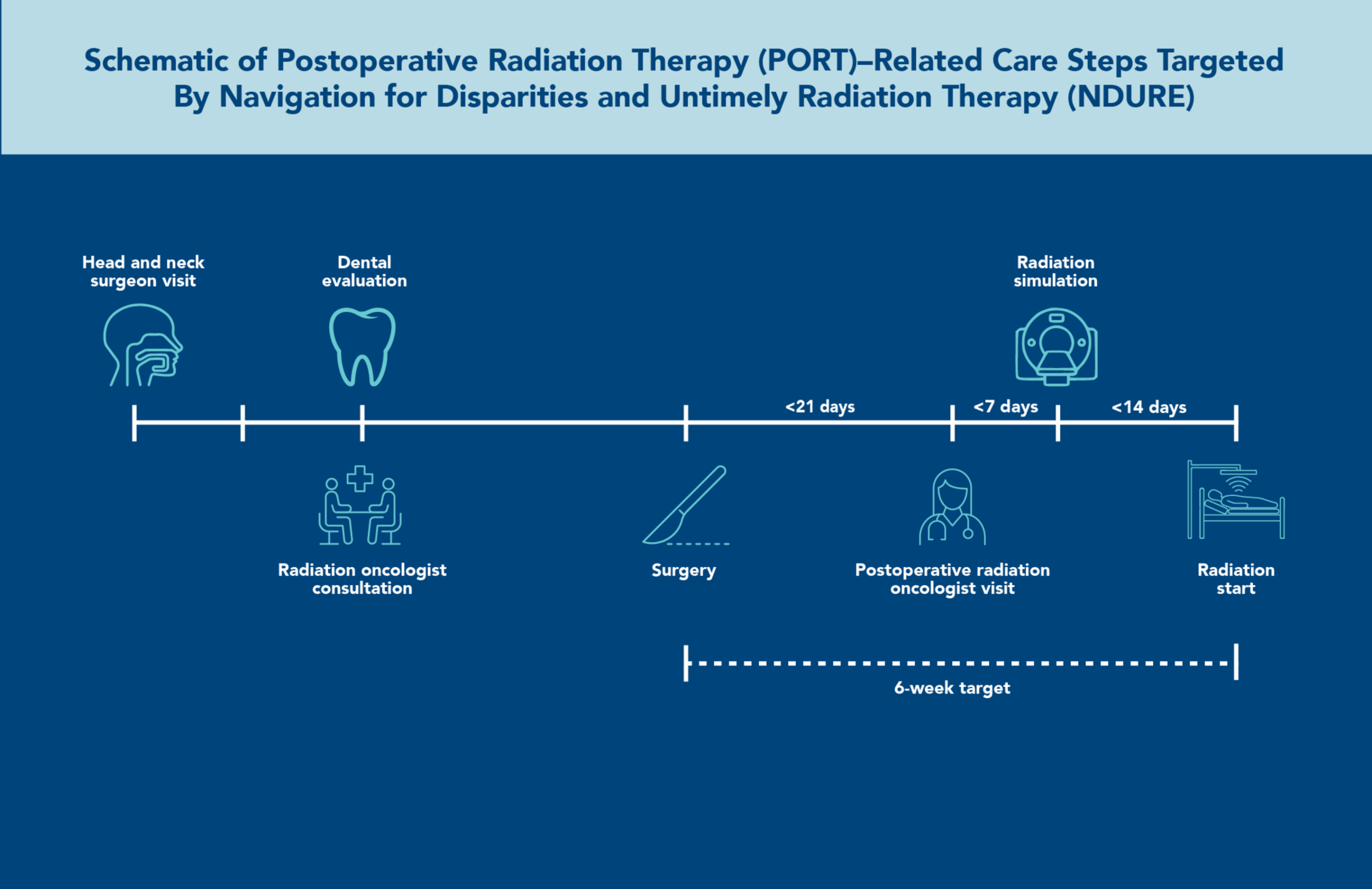
The research team broke the period between surgery and radiation into five key care steps:
- Meeting with a radiation oncologist before surgery.
- Completing a preoperative dental evaluation.
- Seeing a radiation oncologist within 21 days of surgery.
- Completing radiation planning scans promptly.
- Beginning radiation within 14 days of planning scans.
Compared with patients receiving usual care, those enrolled in the enhanced navigation program were significantly more likely to complete these critical care milestones. And the more milestones that patients completed, the more likely they were to begin radiation within the six-week window. Ninety percent of patients who completed four or five care steps started treatment on time, compared with 10% of those who completed one or no steps.
One care step stood out: seeing a radiation oncologist within three weeks after surgery. That milestone accounted for nearly a quarter of the intervention’s overall benefit. The enhanced navigation program also shortened the time to the postoperative radiation oncology visit by about five days compared with usual care.
“If patients don’t meet the radiation oncologist, then all the downstream things that need to happen simply can’t happen,” Graboyes said. “That visit brings the radiation oncology team into the patient’s care, allowing them to move everything else forward.”
A roadmap for cancer centers
Although the study evaluated a patient navigation program, Graboyes said the findings extend beyond navigation itself. The five care steps – not the specific navigation program – are the important targets.
“I don’t think the takeaway is that every health system has to use this exact intervention,” he said. “The takeaway is that these are the targets you should be aiming for. Different health systems may achieve them in different ways.”
That flexibility is especially important at Hollings, where patients across South Carolina often travel for specialized head and neck surgery before returning to their local communities for radiation therapy. Those transitions between health systems can make it more difficult to keep treatment on schedule, underscoring the need for strong communication and coordination among care teams.
I don’t think the takeaway is that every health system has to use this exact intervention. The takeaway is that these are the targets you should be aiming for. Different health systems may achieve them in different ways.
The findings also point to a broader challenge: Delivering cancer treatment often requires far more than one physician or clinical team. For patients with head and neck cancer, surgeons, radiation oncologists, medical oncologists, dentists, nurses, rehabilitation specialists and patient navigators all play a critical role. Their work must be carefully coordinated within just a few weeks as patients recover from major surgery and prepare to begin radiation therapy. Keeping those “teams of teams” connected and coordinated – even when they span different departments or different health systems – is essential.
“It’s not just one team,” Graboyes said. “It’s multiple teams working toward a shared objective. Understanding what makes those teams function effectively together is really at the heart of what is happening here.”
The study suggests that improving communication and keeping teams focused on key milestones, such as ensuring patients see a radiation oncologist within three weeks of surgery, can have a measurable impact on whether patients receive timely treatment.
The Hollings-led NDURE program is now being evaluated in an ongoing National Cancer Institute-funded multicenter clinical trial involving MUSC, Baylor University, Duke University and Washington University in St. Louis. Researchers hope the study will determine whether the approach can improve radiation treatment across a variety of healthcare settings, paving the way for more patients to receive the right care at the right time.
Featured in this story
Evan Graboyes, M.D., MPH
Evan M. Graboyes, M.D., MPH, is a Professor in the Departments of Otolaryngology-Head and Neck Surgery and Public Health Sciences at the Medical University of South Carolina, where he serves as the Medical Director of the Survivorship Program and Director of Survivorship and Cancer Outcomes Research (SCOR) at the NCI-designated Hollings Cancer Center. As a fellowship-trained head and neck surgical oncologist and microvascular reconstructive surgeon, Dr. Graboyes focuses on the removal and reconstruction of benign and malignant head and neck tumors. Dr. Graboyes is certified by the American Board of Otolaryngology-Head and Neck Surgery.
Dr. Graboyes' clinical practice as a head and neck surgical oncologist informs and grounds his research program, which leverages his scientific training in supportive oncology, health behavior, and health services research to understand and address issues in cancer survivorship. Supported by more than $15 million in NCI funding, he has been the Principal Investigator on six NCI-funded trials evaluating cancer care delivery and supportive care interventions among cancer survivors. He has published more than 160 articles related to head and neck cancer, cancer survivorship, and cancer care delivery in leading clinical oncology journals.
At a national level, he is at the forefront of conversations shaping cancer care delivery and cancer survivorship through his work at NRG Oncology/NCORP (Vice Chair, Healthcare Access Research Committee), the American Society of Clinical Oncology (Chair-Elect, Health Policy Committee), the National Cancer Institute (Member, Social Determinants of Health Working Group), and the American Head and Neck Society (Chair, Value & Quality of Care Committee; Liaison, Commission on Cancer). He also serves as the Deputy Editor of JAMA-Otolaryngology Head and Neck Surgery.
Dr. Graboyes was born in St. Louis, Missouri, and raised in Wisconsin. He graduated summa cum laude from Princeton University with degrees in philosophy and public policy. He received his medical degree and completed his otolaryngology residency at Washington University School of Medicine in St. Louis. He completed his head and neck oncologic and reconstructive surgery fellowship at the Medical University of South Carolina, where he also received his Master of Public Health in Health Behavior and Health Promotion. He enjoys being outdoors in the Charleston area with his wife and three children.
Reference
Maya N. Elhage, Emily Kistner-Griffin, Reid DeMass, Bhisham S. Chera, Katherine R. Sterba, Chanita Hughes Halbert, Elizabeth G. Hill, Brian Nussenbaum, Anthony J. Alberg, Megan T. Nguyen, Jason G. Newman, W. Greer Albergotti, Alexandra E. Kejner, Judith M. Skoner, Dauren Adilbay, Michael Bobian, Jennifer L. Harper, John Kaczmar, Savannah A. Zimmerman, Stacy Stewart, Taylor McLeod, Vlad C. Sandulache, David J. Hermandez, Ryan S. Jackson, Sidharth V. Puram, Russel Kahmke, Nosayaba Osazuwa-Peters, Gail Jackson, Garrett T. Wasp, Sue S. Yom and Evan M. Graboyes. Mechanisms Underlying an Enhanced Navigation-Based Intervention to Improve Timely Adjuvant Therapy: A Secondary Analysis of the NDURE Randomized Clinical Trial. JAMA Otolaryngology – Head Neck Surgery [23 July 2026]. doi: 10.1001/jamaoto.2026.1891.
Grants from the National Cancer Institute (K08CA237858; R01CA282165), National Center for Advancing Translational Sciences (UL1TR000062), Biostatistics Shared Resource at MUSC Hollings Cancer Center (P30CA138313) and Triological Society/American College of Surgeons supported this research.

Hayley Kamin
Communications Manager
Hayley Kamin is the communications manager for the Hollings Cancer Center Communications and Marketing team, having joined the team in 2025 after three years as a communications specialist at the National Institutes of Health (NIH). As a science communicator with a Ph.D. from the University of Florida, she has extensive experience translating complex research into clear, engaging content. Her career has included roles at the NIH’s National Institute of Mental Health and the American Psychological Association, where she led content development and editorial strategy, developed science and health communications and worked with researchers and clinicians to strengthen public understanding of research.
Contact Hayley at kamin@musc.edu.
Recent Cancer Research stories