Cancer cells depend on a complex network of signals that tell them when to grow, divide and survive. A family of proteins called RAS sits at the center of many of those signals.
Normally, RAS proteins act like switches. They turn on when a cell receives a signal to grow and turn off when the job is done. But in cancer, that process can go awry, allowing growth signals to stay active when they should be off.
That has made RAS an important target for cancer researchers. But until recently, it seemed like an unlikely target for neuroblastoma.
Now, a preclinical study from researchers at MUSC Hollings Cancer Center suggests that RAS could have potential in treating the rare childhood cancer.
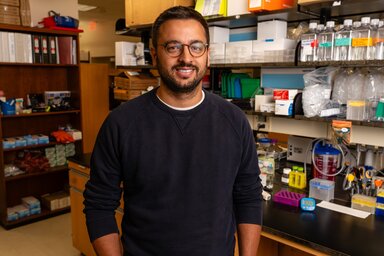
An international team led by John O’Bryan, Ph.D., co-leader of the Hollings Developmental Cancer Therapeutics Research Program, found that blocking RAS slowed the growth of certain neuroblastomas – including those without RAS mutations. The findings suggest that RAS-targeted treatments could benefit more young cancer patients than previously thought.
A difficult cancer to treat
Neuroblastoma is a rare cancer that develops from immature nerve cells and most often affects young children. It can behave very differently from child to child. Some tumors shrink without intensive treatment, while others are aggressive and difficult to control.
The outlook is particularly bleak for children with high-risk neuroblastoma. Despite intensive treatment, only about half achieve long-term remission.
Researchers have long searched for weaknesses in neuroblastoma cells that could lead to new treatment options. RAS could be one of them.
Changes, or mutations, in RAS genes can cause the proteins to become stuck in the “on” position, continuously sending signals that encourage cancer cells to grow.
O’Bryan has spent more than a decade studying RAS and looking for ways to block its cancer-promoting activity. His previous research with longtime collaborator Shohei Koide, Ph.D., of Perlmutter Cancer Center at NYU Langone Health, has led to new ways to target RAS and uncovered vulnerabilities in mutated forms of the protein – work that could guide the development of new cancer drugs.
Now, he is extending that work to neuroblastoma, where RAS presents a new puzzle.
This finding suggests that the new generation of RAS inhibitors recently approved for use in adult pancreatic patients may also prove useful in neuroblastoma patients.
RAS mutations are common in some adult cancers but are found in fewer than 2% of neuroblastomas. However, changes involving RAS are more common when neuroblastoma comes back or stops responding to treatment. Other changes in cancer cells can also make RAS more active, even when the RAS genes themselves are not mutated.
“RAS mutations play an important role in many cancers, including colon, lung and pancreatic cancer, with RAS being mutated in nearly all pancreatic tumors,” explained O’Bryan. “Although RAS mutations in neuroblastoma are quite rare, many neuroblastomas have mutations in genes that may lead to increased RAS activity, suggesting that blocking RAS may be a new approach to treating these neuroblastoma tumors.”
Putting RAS to the test
The researchers first looked at neuroblastoma cells with mutations in KRAS, a gene in the RAS family. They treated the cells with drugs designed to block the specific mutations.
The approach worked as expected. Blocking mutant KRAS proteins disrupted cancer-promoting signals and reduced the cells’ ability to grow, move and form colonies.
But the researchers were especially interested in neuroblastoma cells without RAS mutations. Would these cancer cells still depend on RAS – and could blocking it slow their growth?
To find out, they tested several approaches, including an experimental drug that blocks multiple RAS proteins.
The drug disrupted growth signals in most of the neuroblastoma cell lines tested, regardless of whether they had a RAS mutation. In some cells without RAS mutations, blocking RAS reduced their ability to grow and move – suggesting that these cancer cells were still dependent on RAS.
Not every neuroblastoma responded. But that variation provided an important clue: A RAS mutation may not be the only sign that a tumor depends on RAS. Some neuroblastomas without RAS mutations may still rely on the proteins to grow.
“Our study demonstrates that RAS mutation status is not the only indication for sensitivity to RAS inhibitors,” said O’Bryan. “This finding suggests that the new generation of RAS inhibitors recently approved for use in adult pancreatic patients may also prove useful in neuroblastoma patients.”
The researchers found that these drugs also reduced the growth of the same neuroblastoma cells in mice. Mice receiving the drug survived longer than untreated mice; in one model, survival nearly doubled.
The treatment slowed tumor growth but did not make the tumors disappear completely, suggesting that blocking RAS alone may not be enough. The researchers see potential in eventually combining a RAS-targeted drug with existing neuroblastoma treatments to attack the cancer in multiple ways.
For now, the findings are an early step. The research was conducted in cell and animal models, and additional studies will be needed to determine whether targeting RAS could be a safe and effective treatment for children with neuroblastoma.
“It’s a very exciting time in the RAS field,” said O’Bryan. “After many decades believing that RAS was undruggable, we now have several anti-RAS drugs that are FDA approved. The recent approval of daraxonrasib, Rasonque, for treatment of pancreatic cancer patients has paved the way for extension of this promising therapy to additional cancers, including neuroblastoma.”
Finding the patients most likely to benefit
One of the next challenges will be figuring out why some neuroblastomas depend on RAS while others do not.
In this study, blocking RAS did not affect all neuroblastomas in the same way. Even when a drug successfully disrupted RAS-related growth signals, some cancer cells continued to grow, suggesting they may rely on other signals to survive.
Researchers now need to identify biomarkers, measurable features of a tumor that could predict which neuroblastomas are most likely to respond to RAS-targeted treatments. A RAS mutation and the loss of a tumor-suppressing protein called NF1 emerged as possible clues, but neither fully explained which tumors responded.
Researchers also need to understand how neuroblastomas might become resistant to RAS inhibitors, something that has been observed when used in adult cancers.
Those questions mean a RAS-targeted treatment for neuroblastoma remains a future possibility rather than an option for patients today. But the study offers a new direction – particularly for children with aggressive disease who need more treatment options.
“Our current work is now focusing on defining which subsets of neuroblastoma patients would benefit from RAS inhibition,” said O’Bryan. “In addition, we know from studies in many other RAS-dependent cancers that resistance to RAS inhibitors eventually develops. To address this problem, we are working to define the resistance mechanisms that emerge in neuroblastomas in response to RAS inhibition so that we can develop more effective combination therapies to treat these children.”
Featured in this story

John P. O'Bryan, Ph.D.
The focus of my research is on defining new vulnerabilities in the RAS oncoprotein. Although RAS has been studied for more than 40 years, pharmacologics targeting oncogenic KRAS have been difficult to develop. While great strides have been made in recent years in developing anti-RAS therapeutics, leading compounds target only a single oncogenic mutant, KRAS(G12C) which represents only 15% of oncogenic KRAS mutants in human cancers. My laboratory employs Monobody technology to discover new vulnerabilities in RAS that can be targeted for therapeutic inhibition.
Reference
Mubashir Mintoo, Vinodh Rajagopalan, Rachel Greathouse, Cecile Nasarre, Tarah Trebino, Dianicha Santana, Kevin O. Flores-Galvez, Gayatri Ketavarapu, Akiko Koide, Fiona E. Hood, Ian A. Prior, Mark Philips, Shohei Koide, Bill Chiu and John P. O’Bryan. RAS inhibition limits oncogenic signaling and tumorigenesis in neuroblastoma regardless of RAS mutational status. Scientific Reports [31 July 2026]. doi: /10.1038/s41598-026-63488-x.
This research was funded by grants from the National Cancer Institute (P30CA138313; R01CA212608; P30CA016087), the National Institute of General Medical Sciences (P20GM130457) and the Department of Veterans Affairs Biomedical Laboratory Research and Development Service MERIT Award (1I01BX002095). Additional support came from a Hollings Cancer Center Abney Postdoctoral Fellowship.

Hayley Kamin
Communications Manager
Hayley Kamin is the communications manager for the Hollings Cancer Center Communications and Marketing team, having joined the team in 2025 after three years as a communications specialist at the National Institutes of Health (NIH). As a science communicator with a Ph.D. from the University of Florida, she has extensive experience translating complex research into clear, engaging content. Her career has included roles at the NIH’s National Institute of Mental Health and the American Psychological Association, where she led content development and editorial strategy, developed science and health communications and worked with researchers and clinicians to strengthen public understanding of research.
Contact Hayley at kamin@musc.edu.
Recent Cancer Research stories