Researchers at MUSC Hollings Cancer Center have discovered why a powerful cancer-causing gene mutation rarely appears in pancreatic tumors. The new study, published in Cancer Research Communications, showed that a rare version of the KRAS gene hyperactivates a key cancer-driving pathway so intensely that pancreatic cells self-destruct – essentially burning out before becoming cancerous. The findings shed light on new ways KRAS might be targeted in cancer.
Mutations in the KRAS gene appear in about 95% of pancreatic cancers. But one of those mutations – Q61L – is conspicuously absent. Despite being a potent activator of the KRAS signaling pathway, this form of the gene is rarely detected in patient tumors.
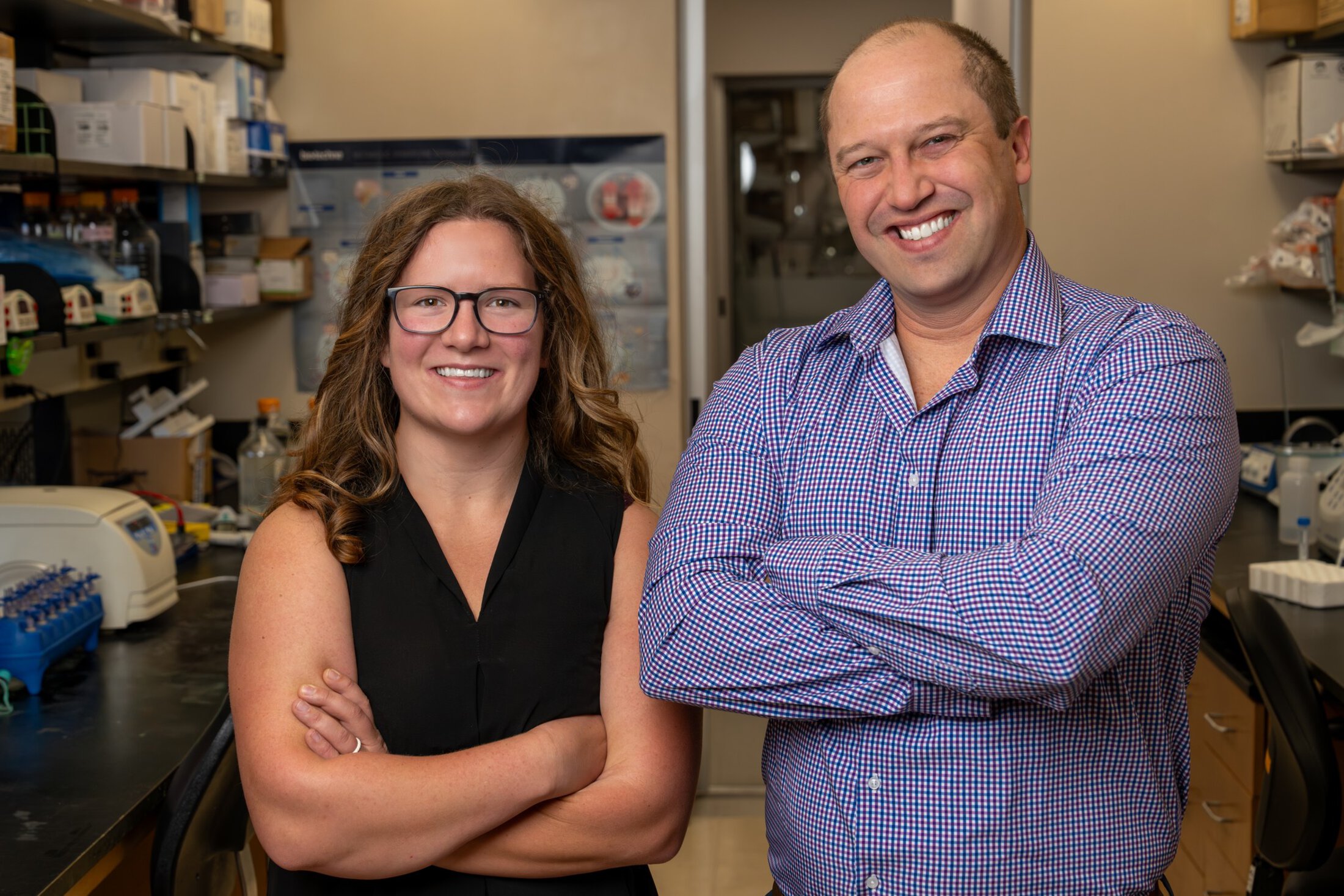
That paradox intrigued Hollings biochemist Aaron Hobbs, Ph.D., and his former doctoral student Rachel Burge, Ph.D., now a medical student at MUSC. Their project drew on expertise across MUSC, including collaborators in the departments of Neuroscience, Biochemistry and Molecular Biology and Pharmacology and Immunology. The research team sought to understand why such a powerful mutation fails to cause pancreatic cancer.
“People have theorized for years that you need just the right amount of signaling to promote cell growth but not so much that it becomes toxic,” Hobbs said. “Our study showed that Q61L pushes cells over that edge.”
We’ve long had this idea that there’s a ‘Goldilocks zone’ for cellular signals that drive cancer growth. This paper is the first experimental evidence of that concept in pancreatic cancer.
A gas pedal stuck in overdrive
The KRAS gene produces a protein that acts like an on/off switch for pathways controlling cell growth, differentiation and survival, especially a central pathway involved in that process known as the RAS/MAPK pathway. When mutated, the switch is stuck in the “on” position, continuously telling cells to divide. This uncontrolled proliferation contributes to cancer, and KRAS mutations are among the most common cancer-causing factors, particularly in pancreatic cancer.
“KRAS acts like a gas pedal,” Burge said. “When cells grow or divide, KRAS pushes that pedal down. But when it’s mutated, it’s like the pedal gets stuck and cells just keep accelerating.”
What puzzled Hobbs and Burge is why some KRAS mutations appear more often in certain cancers. The G12D mutation dominates all cancers, including pancreatic, whereas the Q61L mutation is found at low levels in lung and colon cancers but is rarely found in pancreatic tumors.
“The Q61L mutation is one of the strongest activators of KRAS that we know of,” Hobbs said. “So the question becomes: ‘If it’s such a potent driver, why doesn’t Q61L show up in pancreatic cancer?’”
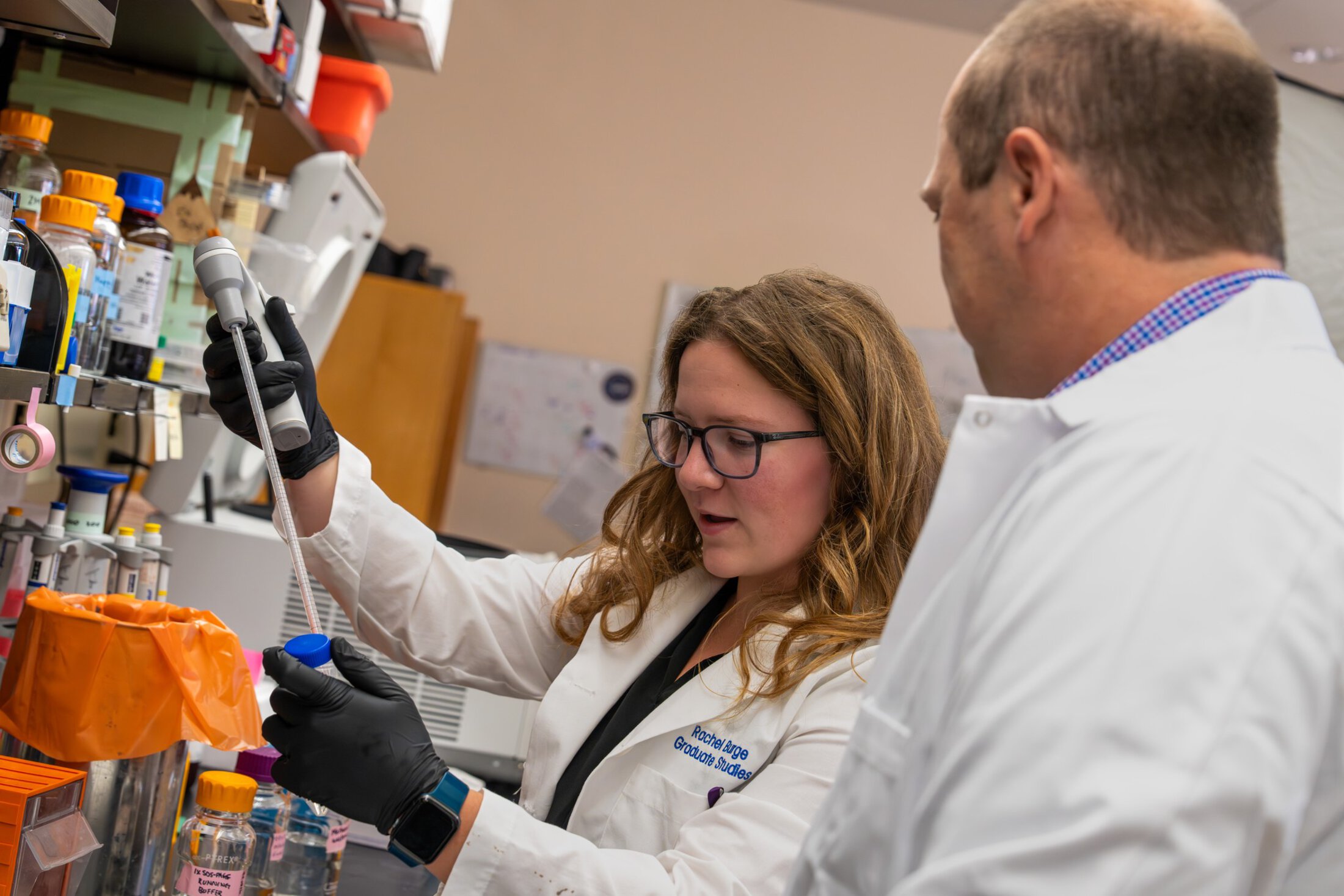
To explore that question, the researchers used a doxycycline-inducible system – a molecular dimmer switch that allowed them to control the amount of different KRAS proteins cells produced. Adding doxycycline to pancreatic cells turned the mutation on, whereas removing it turned the mutation off. This setup allowed them to compare the KRAS Q61L and G12D mutations directly.
“We could essentially ‘turn on’ the mutant KRAS when we added doxycycline,” Burge explained. “That allowed us to look at the earliest effects of these mutations in pancreatic cells and compare them side by side.”
The “Goldilocks” of cancer signaling
At first, the results were puzzling. Even when expressed at much lower levels, Q61L switched on the RAS/MAPK pathway far more strongly than did G12D. But instead of growing, the cells died off. When the team measured apoptosis, which is the process of programmed cell death, they found clear evidence that Q61L was, in fact, driving the cells to self-destruct.
“Rachel kept telling me, ‘I can’t get the Q61L cells to grow, they just keep dying,’” Hobbs recalled. “It turned out that was the story: As you increase the level of Q61L, you drive apoptosis. The cells can’t tolerate that level of signaling.”
To understand why, the team next used mass spectrometry and RNA sequencing – sophisticated techniques that revealed which proteins come into close contact with the KRAS proteins – to map the downstream effects of each mutation. Working with the MUSC Mass Spectrometry Facility, they found that Q61L interacted strongly with proteins in the RAS/MAPK pathway.
“The results suggest that Q61L isn’t doing something different than G12D,” Burge said. “It is doing the same thing as other KRAS mutations – it is just doing too much of it.”
The results provide experimental evidence for what scientists call the “Goldilocks” hypothesis of RAS/MAPK signaling: Cancer cells need their growth pathways to be activated but not excessively. Too little signaling and cells do not become cancerous; too much signaling and cells die off.
That’s a really exciting direction for future research and a benefit of doing basic science. Q61L might be rare, but it’s teaching us a lot about how cancer works.
“We’ve long had this idea that there’s a ‘Goldilocks zone’ for cellular signals that drive cancer growth,” Hobbs said. “This paper is the first experimental evidence of that concept in pancreatic cancer.”
Final experiments revealed what was happening inside the cells. Q61L’s overactive signaling caused unusually high activity in the cell nucleus, where growth signals are translated into gene expression, sending an overload of the last protein in that pathway into the nucleus and turning on genes tied to stress, growth and cell death. This surge overwhelmed the cells and triggered them to self-destruct.
“This last step helped us show not just that Q61L is overactive – but how it’s overactive,” Burge said.
Implications for targeting KRAS
Understanding why certain KRAS mutations fail to thrive in specific tissues could guide the development of new cancer therapies. For instance, drugs that mimic Q61L’s hyperactivation might be used to cause cancer cells to go into the same fatal overdrive.
“Could we push cancer cells past their comfort zone, making them burn out like Q61L does – without harming normal cells?” Burge asked. “That’s a really exciting direction for future research and a benefit of doing basic science. Q61L might be rare, but it’s teaching us a lot about how cancer works.”
Hobbs agreed, noting that this work connects to his earlier studies on another unusual KRAS variant that is found almost exclusively in pancreatic cancer. Together, these studies reveal that each KRAS mutation has its own biological “personality,” shaped by tissue type and signaling context.
“Not all KRAS mutations are created equal,” Hobbs said. “Understanding why some thrive and others don’t could offer new strategies for targeting them. If we can mimic that hyperactivation safely, we might one day have a new way to destroy KRAS-driven tumors.”
Rachel A. Burge, Lucas Bialousow, Thomas McFall, Logan Bamonte, Grayson Johnson, Merissa Smith, Silvia G. Vaena, Susana Comte-Walters, Lauren E. Ball, Stefano Berto, John P. O’Bryan and G. Aaron Hobbs. Pancreatic Cells Are Resistant to KRASQ61L Expression due to Hyperactive ERK/MAPK Signaling and Apoptosis Induction. Cancer Research Communications. [22 October 2025]. doi: 10.1158/2767-9764.CRC-25-0281.
Grants from the National Institute of Health’s National Cancer Institute (P30CA138313, R01CA212608, R01CA276771), National Institute of Diabetes and Digestive and Kidney Diseases (P30DK123704) and National Institute of General Medical Sciences (P20GM123456, P20GM130457, P20GM148302), the Department of Veterans Affairs (1I01BX002095), the American Cancer Society (IRG #19-138-34), the Pancreatic Cancer Action Network (22-20-HOBB), and the Concern Foundation supported this research.

Hayley Kamin
Communications Manager
Hayley Kamin is the communications manager for the Hollings Cancer Center Communications and Marketing team, having joined the team in 2025 after three years as a communications specialist at the National Institutes of Health (NIH). As a science communicator with a Ph.D. from the University of Florida, she has extensive experience translating complex research into clear, engaging content. Her career has included roles at the NIH’s National Institute of Mental Health and the American Psychological Association, where she led content development and editorial strategy, developed science and health communications and worked with researchers and clinicians to strengthen public understanding of research.
Contact Hayley at kamin@musc.edu.
Recent Cancer Research stories