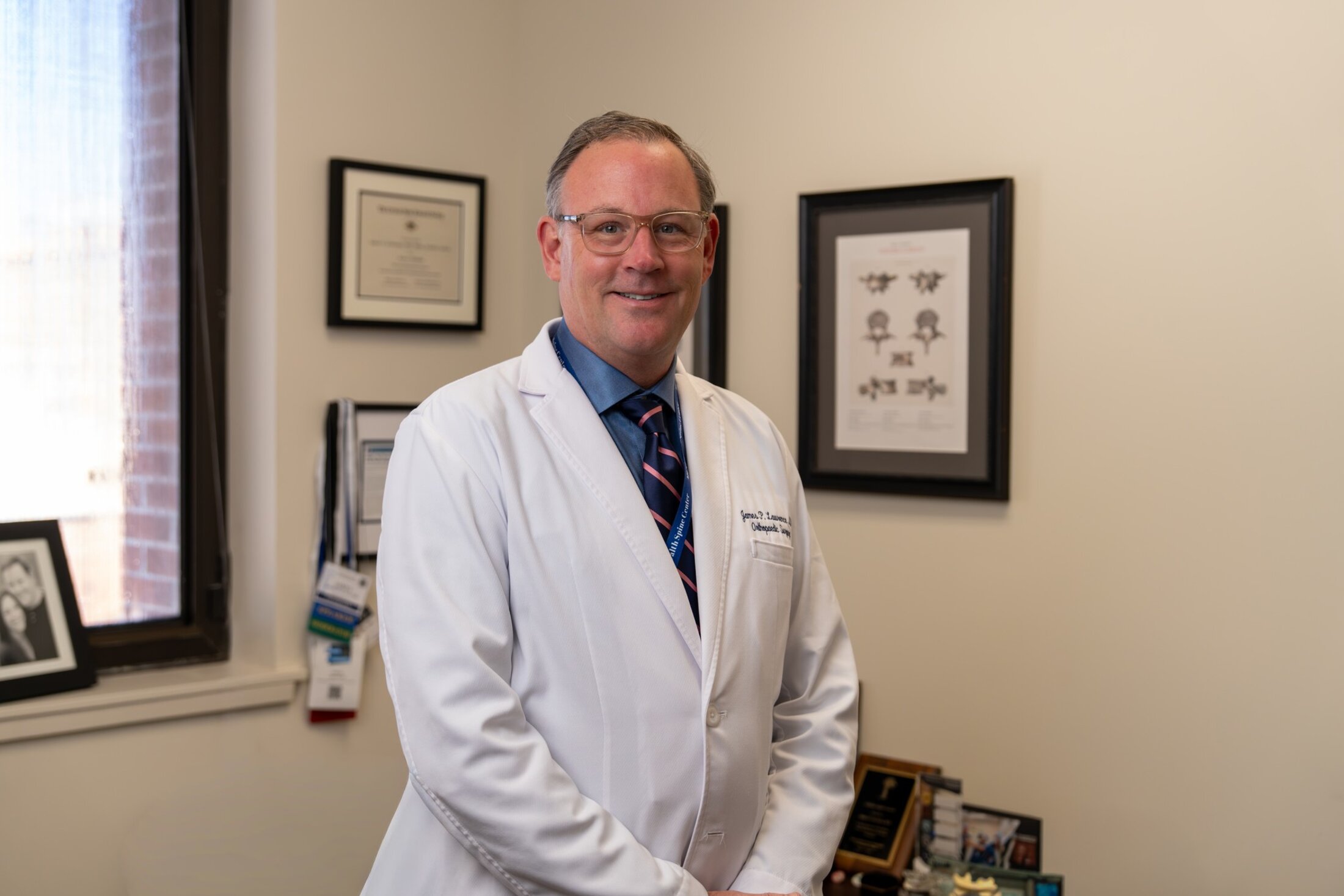
MUSC spine surgeon James Lawrence, M.D., has performed South Carolina’s first spinal tumor surgery using carbon fiber implants – marking a milestone for MUSC Health and expanding surgical options for patients with spinal tumors.
Implants help to give strength and stability to the spine after removing a tumor. These implants are usually made of titanium, a metal that is lightweight and strong and integrates well with bone. But titanium also creates “artifacts” on scanned images, much like streaks of bright sunlight obscuring the subject in a photograph.
The icotec BlackArmor Carbon/PEEK implants are more similar to natural bone, which means CT and MRI images of the area around the implants are much clearer. Clear images allow radiation oncologists to plan follow-up treatment more precisely and surgeons to monitor for the cancer’s return in more detail.
“This technology is really a positive step forward,” Lawrence said. “It allows us to provide better-quality care by improving the imaging our radiation oncology colleagues rely on and helping them deliver more precise treatment.”
How carbon fiber implants improve cancer care
The first patient to receive the new carbon fiber implants at MUSC Health had cancer that had spread to the spine. He was enrolled in a clinical trial at MD Anderson Cancer Center when worsening back pain and leg weakness led him to seek emergency care closer to home.
Because the patient would also need radiation therapy after surgery, Lawrence and the care team had to consider not only how best to stabilize his spine but also how the implants might affect the treatment that followed.
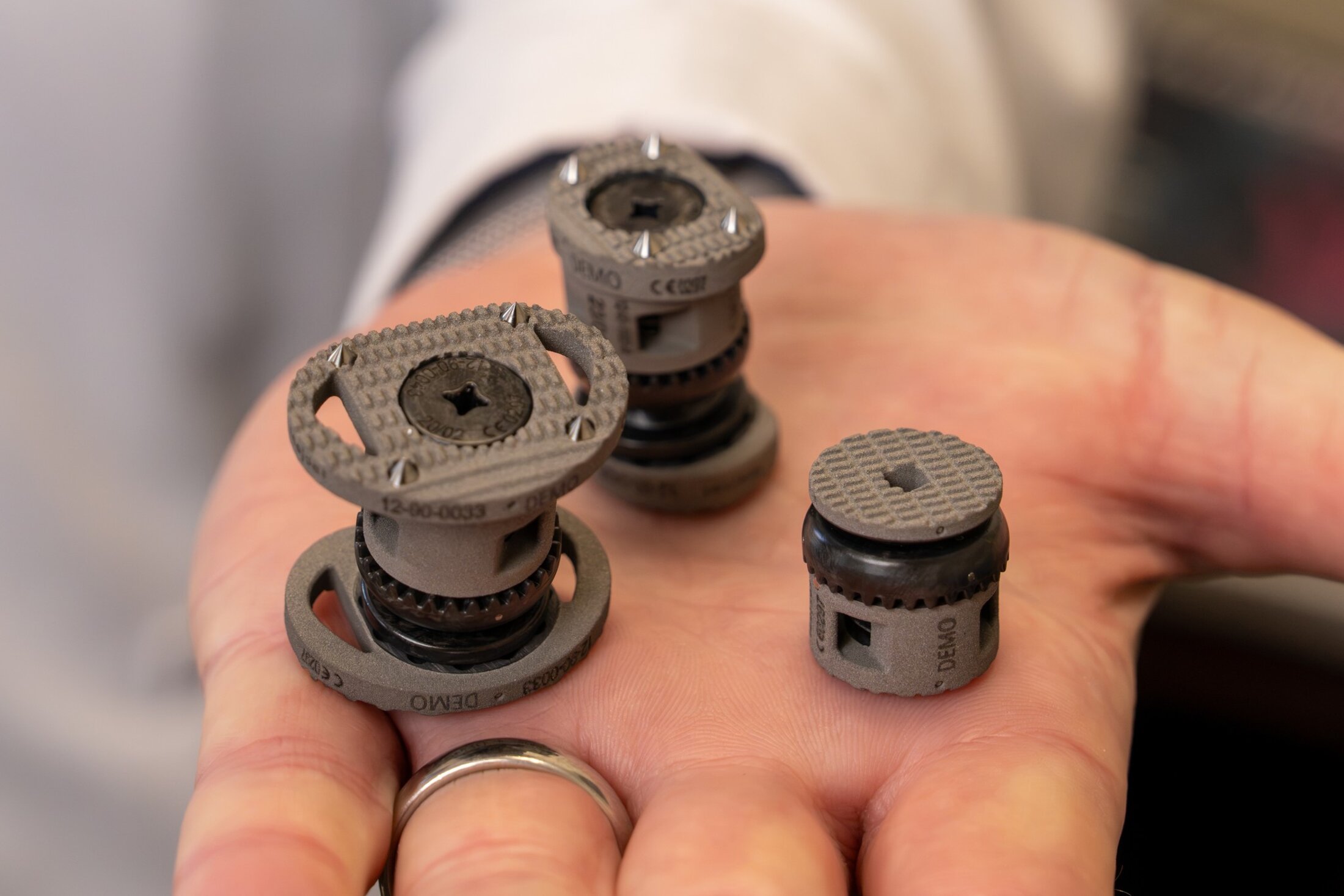
“When we’re planning radiation, we need to clearly see the spinal cord, the surrounding fluid, the bones and the remaining tumor,” said Brian Lally, M.D., a radiation oncologist at MUSC Hollings Cancer Center who administered the patient’s radiation therapy. “Traditional metal implants limit that level of detail. Carbon fiber implants don’t create the same type of artifact, so we’re able to achieve a level of precision that wasn’t possible before.”
That improved visibility is valuable when treating spinal tumors with highly targeted radiation.
“We’ve developed technology where we can use radiation almost like a scalpel. But instead of making an incision, we’re precisely sculpting high doses of radiation to the tumor while avoiding nearby healthy tissue,” Lally said. “The carbon fiber implants help us do that job better because they allow us to distinguish the tumor from nearby critical structures. That lets us deliver high doses of radiation while minimizing risk to the spinal cord.”
The clearer imaging also benefits patients after treatment. Because carbon fiber implants create less interference on follow-up scans, physicians can better monitor patients for signs that a tumor has returned.
“Patients with spinal tumors often undergo surveillance imaging for years,” Lawrence said. “Providing higher-quality scans offers greater reassurance for both physicians and patients.”
For MUSC’s first patient, the technology supported a rapid transition from surgery to the next phase of treatment. After Lawrence performed the minimally invasive procedure, the patient was able to return home the following day and begin radiation therapy two weeks later.
We’re seeing cancer become more of a chronic disease. Our goal is to work together to preserve critical structures like the spine for as long as possible while helping patients maintain their quality of life.
“The alternative would have been a much larger operation with a longer recovery and less-than-ideal radiation planning,” Lawrence said. “This allowed us to perform a less invasive surgery and helped the patient recover quicker and continue their treatment sooner.”
Teamwork across specialties improves patient care
The milestone highlights the collaboration among spine surgeons, radiation oncologists, medical oncologists, nurses, operating room staff and emergency medicine teams involved in caring for patients with spinal tumors.
“I give huge credit to everyone involved," Lawrence said. “This is true multidisciplinary care.”
As advances in cancer treatment allow patients to live longer, that collaboration will become more important than ever, Lally said.
“We’re seeing cancer become more of a chronic disease. Our goal is to work together to preserve critical structures like the spine for as long as possible while helping patients maintain their quality of life.”
Bringing carbon fiber spinal implant technology to South Carolina also means more patients can access advanced spine cancer care without leaving the state.
“We’re able to offer patients treatment options they might otherwise have to travel elsewhere to receive,” Lawrence said. “We can take care of an enormous range of complex problems here at a very high level.”
For Lally, providing that level of care is ultimately about honoring the trust that patients place in their care team.
“Every patient inspires me,” he said. “They give me the opportunity to learn something new, and we owe it to them to make sure we’re offering the latest, most advanced treatments available. This is one more example of us doing exactly that.”
Featured in this story
Brian Lally, M.D., FACRO
- Radiation Oncology
- Gastrointestinal Cancer
- Lung Cancer
- Prostate Cancer
- Charleston, SC
- Mount Pleasant, SC
James Lawrence, M.D., MBA
- Orthopaedic Surgery
- Spine Surgery
- Summerville, SC
- West Ashley, SC
Hayley Kamin
Communications Manager
Hayley Kamin is the communications manager for the Hollings Cancer Center Communications and Marketing team, having joined the team in 2025 after three years as a communications specialist at the National Institutes of Health (NIH). As a science communicator with a Ph.D. from the University of Florida, she has extensive experience translating complex research into clear, engaging content. Her career has included roles at the NIH’s National Institute of Mental Health and the American Psychological Association, where she led content development and editorial strategy, developed science and health communications and worked with researchers and clinicians to strengthen public understanding of research.
Contact Hayley at kamin@musc.edu.
Recent Cancer Care stories