
I recently had the opportunity to represent MUSC Hollings Cancer Center at the 32nd European Cell Death Organization (ECDO) Conference, “Death on the Beach: Cell Death & Disease.” It was a great opportunity to engage with scientists who think about diseases from the perspective of cell death, stress, survival, and adaptation.
The meeting brought together an impressive group of investigators from around the world. One of the highlights was hearing Nobel Prize winner Aaron Ciechanover, M.D., D.Sc. The presentations, and the many discussions throughout the meeting, provided a reminder of how much we still have to learn about the ways cancer cells respond to stress and avoid death.
I was excited to give a short talk, "Adaptive Stress Response, Death and Lymphatic Invasion." I shared some of our recent work (see references below) in inflammatory breast cancer, focusing on how tumor cells adapt to the stresses they encounter as they invade and disseminate through the lymphatic system. Our work has led us to think about adaptive stress response not simply as a mechanism that helps tumor cells survive, but as a process that may create specific vulnerabilities that we can eventually target therapeutically.
Some of the most interesting conversations about new ideas, potential collaborations, and where the field is going next happened outside the formal sessions including at the fabulous Gala Dinner. Meetings like ECDO remind us that advances in cancer research often emerge at the intersection of fields, and that rare and aggressive cancers such as inflammatory breast cancer can provide important biological insights that extend well beyond the disease itself.
The setting made the meeting especially memorable. Favignana, Sicily, is a Mediterranean island with a rich history, from the ancient naval battle between Rome and Carthage in 241 B.C. to its famous tuna fishing and canning industry developed by the Florio family in the 19th century. The historic Florio tuna factory remains a landmark on the island. Against this backdrop, the meeting’s title, “Death on the Beach,” took on an interesting meaning, bringing together the island’s history of battles, tuna fishing and canning with our scientific focus on cell death and disease.
Multiscale modeling uncovers macrophage infiltration and TNF-α signaling networks for targeting in inflammatory breast cancer tumor emboli.
Pai P, Van Berckelaer C, Van Laere S, Bennion A, Charity T, Yang J, Bertucci F, Van Dam P, Palmer GM, McCall S, Dirix LY, Ueno NT, Devi GR.
Breast. 2026 Oct;89:104890. doi: 10.1016/j.breast.2026.104890. PMID: 42607569
Tumor emboli-associated adaptive stress response signatures identify aggressive disease features in inflammatory breast cancer.
Pai P, Hsu H, Manyam GC, Laere SV, Mysona DP, Hawkins WG, Krishnamurthy S, Kai M, Diao L, Woodward WA, Devi GR.
bioRxiv [Preprint]. 2026 Jul 8:2026.07.06.734332. doi: 10.64898/2026.07.06.734332.
PMID: 42465497
3D Engineered Biomimetic Platform for Characterization of Collective Invasion, Tumor Emboli Formation, and Lymphatic Dissemination.
Way C, Erdmann RF, Gearhart-Serna L, Pai P, Roman N, Klitzman B, Devi GR.
IEEE Open J Eng Med Biol. 2026 Feb 23;7:119-127. doi: 10.1109/OJEMB.2026.3666977. eCollection 2026.
PMID: 41970649
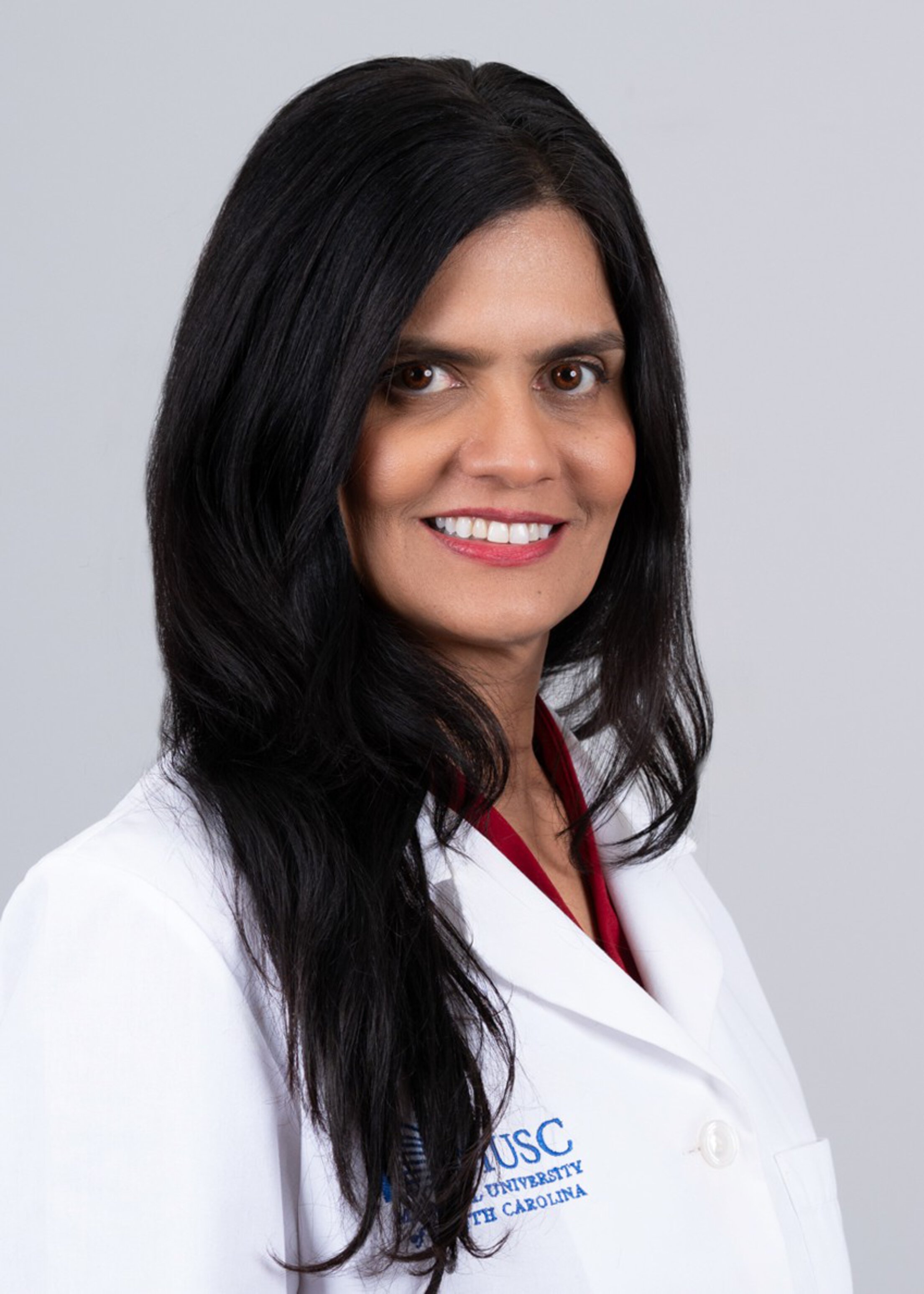
Gayathri Devi
Director, Scientific Program Integration, Hollings Cancer Center Vice Chair of Innovation, Surgery Professor, Surgical Oncology
Nationally recognized for her leadership, Gayathri Devi, Ph.D., MS, was the inaugural director of the Duke: North Carolina Central University Bridge office at the Duke Clinical and Translational Sciences Institute (CTSI) and has served on the Board of Directors of the Association for Clinical and Translational Sciences (ACTS). She is currently a Board Member and President of the International Consortium for Inflammatory Breast Cancer (IBC-IC). In 2025, ACTS honored her with the Addressing Health Equity through Partnership and Innovation Award.
Dr. Devi joined MUSC in 2025. She holds dual roles with Hollings Cancer Center and the MUSC Department of Surgery.
Her research spans programmed cell death, functional genomics, tumor immunology with a translational focus across oncology and surgical sciences. With continuous federal funding, philanthropic support, and extensive international collaborations across Europe, Africa, and Asia, she has built highly productive partnerships with clinicians, cancer biologists, engineers, computational scientists, population health experts, behavioral scientists, and community stakeholders. These multidisciplinary collaborations foster population-conscious, bidirectional engagement projects rooted in a “bedside to bench to curbside and back” cyclical framework that directly improves health outcomes.
Recent Cancer Conference Perspectives stories