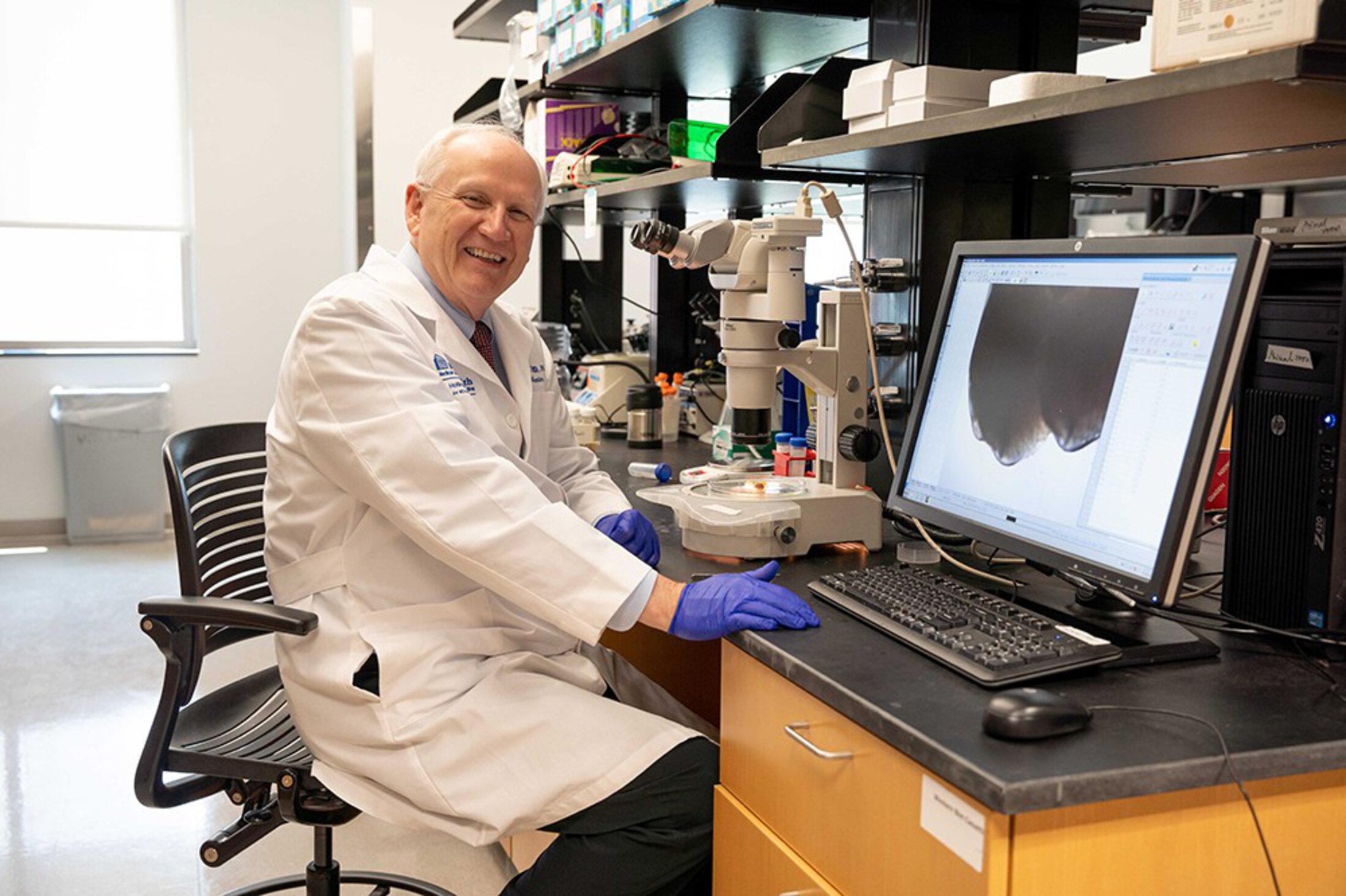
A new study from MUSC Hollings Cancer Center researchers shows, for the first time, that a receptor called PPAR δ, or peroxisome proliferator-activated receptor delta, is an important player in a pathway that disables the immune system so that T-cells can’t kill cancer cells.
Led by Raymond N. DuBois, M.D., Ph.D., director of Hollings, the researchers published their findings in Cancer Research Communications.
DuBois said they used a man-made ligand, or molecule that binds to a receptor, called GW501516. It was initially developed with the expectation that it could treat conditions like diabetes and obesity but was mostly abandoned for use in such metabolic conditions because of the possibility that it could increase cancer risk.
“It binds to and activates the PPAR δ nuclear receptor. When you turn it on, it promotes cancer. It can stimulate cell proliferation and affect inflammatory pathways,” DuBois said.
“We found that it modifies the ability of the immune system to attack and kill cancer cells. So it allows the tumor cells to evade attack by the immune system.”
DuBois noted that his lab published a report 20 years ago that mice treated with GW501516 showed a dramatic increase in tumor burden.
Now, he said, this new paper “has identified a key mechanism for how that works because normally the immune cells would kill pre-cancer cells and get rid of them. Following PPAR δ activation, the immune cells lose their ability to kill cancer cells.”
This happens because when PPAR δ is activated, it suppresses the binding of transcription factor RelA to DNA, affecting NF-kappa B, a molecule that regulates immune responses.
Although GW501516 is manmade, its actions likely mimic what happens when people eat diets high in fat, which does correlate with tumor burden in the Apc mutant mice.
This finding opens up possibilities for researchers looking for new immunotherapy targets as they develop drugs against cancer, said first author Bo Cen, Ph.D., a research assistant professor in the DuBois Lab.
“This could present us an opportunity to target PPAR δ in immunotherapy,” Cen said.
"Although immunotherapy has had some success in certain cancer types, some patients do not respond well and, with time, actually show a resistance.”
DuBois said his lab is now working with a PPAR δ antagonist, a substance that stops an effect, to see if antagonizing the receptor leads to a fully enabled immune system.
“There's a way to turn it on and turn it off, and we will investigate whether using the drug that turns it off has a potential therapeutic impact in preclinical studies.”
Cen. B., Wei, J., Wang, D. and DuBois, R.N. Peroxisome Proliferator–Activated Receptor δ Suppresses the Cytotoxicity of CD8+ T Cells by Inhibiting RelA DNA-Binding Activity, Cancer Research Communications (2024) 4 (10): 2673–2684, https://doi.org/10.1158/2767-9764.CRC-24-0264
This work was supported in part by the DOD grant W81XWH (to R.N. DuBois) and Flow Cytometry & Cell Sorting Unit, Hollings Cancer Center, Medical University of South Carolina (P30 CA138313). We thank Drs. Nathan Dolloff and Lety Reyes Angeles at the Medical University of South Carolina for sharing the Nucleofector II device (Lonza).

Leslie Cantu
Senior Communications Manager
Leslie Cantu is the senior communications manager at MUSC Hollings Cancer Center, where she works with researchers, clinicians and patients to tell the people of South Carolina about the innovative work being done to improve cancer care for everyone in the state. She joined the MUSC Office of Communications and Marketing in 2018 after a career as an award-winning writer, editor and producer at community newspapers and local TV news. She transferred to the communications office at Hollings in 2022, where she happily finds something new and interesting to write about every day. Her favorite stories to cover at MUSC have included Match Day, the Angel Tree Parade, a clinical trial of CAR-T cell therapy and the many patients who have agreed to share their very personal struggles and triumphs.
Contact Leslie at cantul@musc.edu.
Recent Cancer Care stories