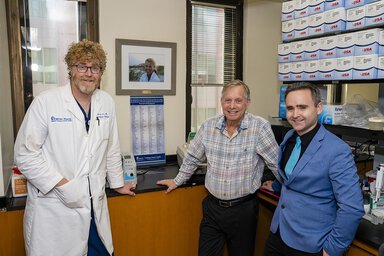
The one thing that Dr. Orr said that stuck out to me the most was he wanted to keep me on a curative path. It was the best thing he could have said to me because it gave me that hope right off the bat that he's got me.




Ovarian cancer is cancer of the ovaries, the gland in the female reproductive system that produces eggs. If you have received a diagnosis of ovarian cancer, it is important that you be treated by a skilled team that includes gynecologic oncologists who have extensive experience treating ovarian cancer. At MUSC Hollings Cancer Center, the only NCI-designated cancer center in South Carolina, your ovarian cancer care will be overseen by a team of gynecologic oncologists who can provide a range of options that include surgery, chemotherapy and targeted therapies, and you can rest easy knowing that University Medical Center, the hospital where our gynecologic oncologists operate, has been rated as high-performing for ovarian cancer surgery by U.S. News & World Report.
Our experts will consider the best course of treatment for you and might suggest you are a good match for an ovarian cancer clinical trial. Clinical trials provide the opportunity to have access to the newest therapies that could become the standard of care in the future.
Hollings Cancer Center is recognized as High Performing in Gynecologic Cancer Surgery in the 2026–2027 U.S. News & World Report rankings. This honor reflects our team’s expertise in treating cancers of the female reproductive system—using multidisciplinary care, minimally invasive techniques, and patient-focused support to achieve outcomes above national benchmarks.
Ovaries are the glands in the female reproductive system that produce eggs and the hormones estrogen and progesterone. Cancer that begins in an ovary or fallopian tube — the tubes that connect the ovaries to the uterus — is called ovarian cancer. Ovarian cancer isn’t as common as other cancers, but it ranks as the fifth most common cause of cancer death for women and the top cause of cancer death connected to the reproductive system.
One of the reasons that ovarian cancer ranks so highly among cancer deaths is because it is difficult to diagnose at an early stage. Localized ovarian cancer, or cancer that hasn’t spread, has a five-year survival rate of 93%. However, the majority of ovarian cancers are diagnosed after they have metastasized, or spread through the body. For this reason, it is especially important to be alert to changes in your body and to discuss them with your doctor.
Have more questions about ovarian cancer? Check out our answers to common questions.
Ovarian cancer often doesn’t show any signs or symptoms at early stages. When the cancer does cause symptoms, those symptoms can be mistaken for other problems, like irritable bowel syndrome. The following symptoms don’t always mean that you have cancer, but they do mean you should consult with your doctor and consider the possibility of ovarian cancer:
The one thing that Dr. Orr said that stuck out to me the most was he wanted to keep me on a curative path. It was the best thing he could have said to me because it gave me that hope right off the bat that he's got me.
Treatment for ovarian cancer depends upon whether the cancer has spread outside the ovaries, your health and your age. You and your doctor will discuss which option is best for you.
Our treatment options include:
Our team is trained in the use of laparoscopic surgery and the da Vinci Surgical System, a robot that helps to increase surgical precision. These techniques are used for:
To refer an ovarian cancer patient to Hollings, please call 843-985-0585. If you are a referring provider, please submit our GYN Oncology Referral Form.
You and your doctor will discuss the pros and cons of each option and decide on the best course of treatment for you. Our gynecologic cancer nurse navigators will help you understand what to expect during treatment and answer questions you may have. Our navigators include Antonio Rivera, BSN, RN, OCN (riveraa@musc.edu), at Hollings Cancer Center in downtown Charleston and Brooke Winkler, MSN, RN (winklebr@musc.edu), at North Charleston, Mt. Pleasant, and Okatie. We also have Patty Parnell, BSN, RN (parnellp@musc.edu), at MUSC Health Gynecology Oncology at Tidelands Health in Murrells Inlet and Ainsleigh Brown, BSN, RN (brownain@musc.edu), at Florence.
Call 843-792-9300 to schedule an appointment with one of our gynecologic cancer specialists.
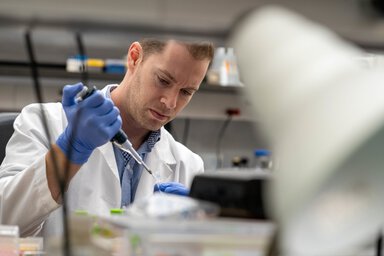
Our researchers and scientists conduct groundbreaking research and clinical trials to continually search for more effective ways to diagnose and treat ovarian cancer. Some recent projects include:
In addition, Hollings’ Gynecologic Oncology Transdisciplinary Cancer Team brings together expertise from different disciplines in basic and clinical research to collaborate on ongoing gynecologic cancer research.
As South Carolina’s only NCI-designated cancer center, Hollings offers you clinical trials and treatments that aren’t available anywhere else in the state. Learn more about clinical trials at Hollings and see our current ovarian cancer and gynecologic cancer clinical trials. By participating in a clinical trial, you may benefit from therapies that will one day be considered standard treatment.
Through our partnership with the Gynecologic Oncology Group and NRG Oncology, Hollings is also able to offer you additional opportunities to participate in national Phase III clinical trials specific to gynecologic cancers, providing access to cancer-fighting agents not yet available in regular practice.


Ovarian cancer survivor Carol Sullivan shares the ups and downs of her cancer journey and talks about the support and positivity that helped carry her through treatment.
There are some risk factors that have been associated with ovarian cancer. Some of these risk factors can be mitigated. For example, the Hollings Hereditary Cancer Clinic can test for genetic mutations that are known to make ovarian cancer more likely and can advise you on next steps if your test shows that you have one of these mutations.
The most common risk factor for cancer overall is age, and ovarian cancer is more likely in women who have gone through menopause. You should be aware of the risk factors listed below and talk to your doctor if any of these apply to you. But you should also know that, aside from age, most women who are diagnosed with ovarian cancer don’t have these risk factors. Risks for ovarian cancer include:
An average-risk woman has about a 1% to 2% chance of developing ovarian cancer in her lifetime. However, because there is no effective screening test for ovarian cancer, gynecologists and gynecologic oncologists now recommend that women at average risk for ovarian cancer consider having their fallopian tubes removed if they are already scheduled for another surgery, like a C-section or removing cysts. Removing the fallopian tubes should reduce your risk of most types of ovarian cancer, which are believed to begin in the fallopian tubes and spread to the ovaries.
Removing the fallopian tubes means you cannot get pregnant, so this option is for average-risk women who are finished with childbearing or do not wish to have children. Specialists currently recommend removal only if you are already having another surgery. Surgery for the sole purpose of removing the fallopian tubes isn’t recommended because the risks of surgery are about equal to the risks of developing cancer.
Women who are at high risk of ovarian cancer, because they have gene mutations that can cause ovarian cancer, should schedule an appointment with the Hollings Hereditary Cancer Clinic to discuss their options. For someone who is high risk, removal of both the ovaries and the fallopian tubes may be recommended.

Ovarian cancer is somewhat rare. Less than 1% of all cancer diagnoses are ovarian cancer. However, ovarian cancer is the fifth most common cause of cancer death among women.
The five-year survival rate for ovarian cancer when it is localized is 93%. For regional cancer it is 74% and for distant cancer it is 31%.
There aren’t routine screening tests for ovarian cancer. If you are experiencing symptoms, your doctor may conduct a pelvic exam. Other tests include transvaginal ultrasound or a blood test that looks for a protein that can be elevated in people with ovarian cancer. To make an official diagnosis, a biopsy is needed.
The Pap test is designed to screen for cervical cancer, not ovarian cancer. Scientists are looking for a reliable screening test for ovarian cancer but in the meantime, you should be aware of potential signs of ovarian cancer and talk to your doctor about symptoms. If you have a family history of ovarian cancer, consider having genetic testing done.
Your treatment will depend on how far along the cancer is, but surgically removing the ovaries is the usual treatment. If the cancer is found at a very early stage and is in only one ovary, and you want to have children, the surgeon might be able to remove the ovary with cancer and leave the other. Talk to your doctor about your treatment options.
Right now, there aren’t accurate screening tests for ovarian cancer. Instead, pay attention to any changes in your body, like bloating, belly or back pain, vaginal bleeding, constipation or a frequent urge to urinate — especially if these changes persist.
Everything that we know about how to treat cancer comes from clinical trials. By participating in a clinical trial, you could potentially receive more effective treatments that will become standard in the future. You will also be contributing to science that could help thousands of other patients like you.