A new grant from the American Cancer Society (ACS) is helping researchers at MUSC Hollings Cancer Center as they investigate how subtle breakdowns in the way that cells read and repair DNA can lead to ovarian cancer.
DNA normally functions as a carefully organized instruction manual, guiding how cells grow, divide and repair damage. In cancer, those instructions can become scrambled – a breakdown known as genomic instability that drives tumor development.
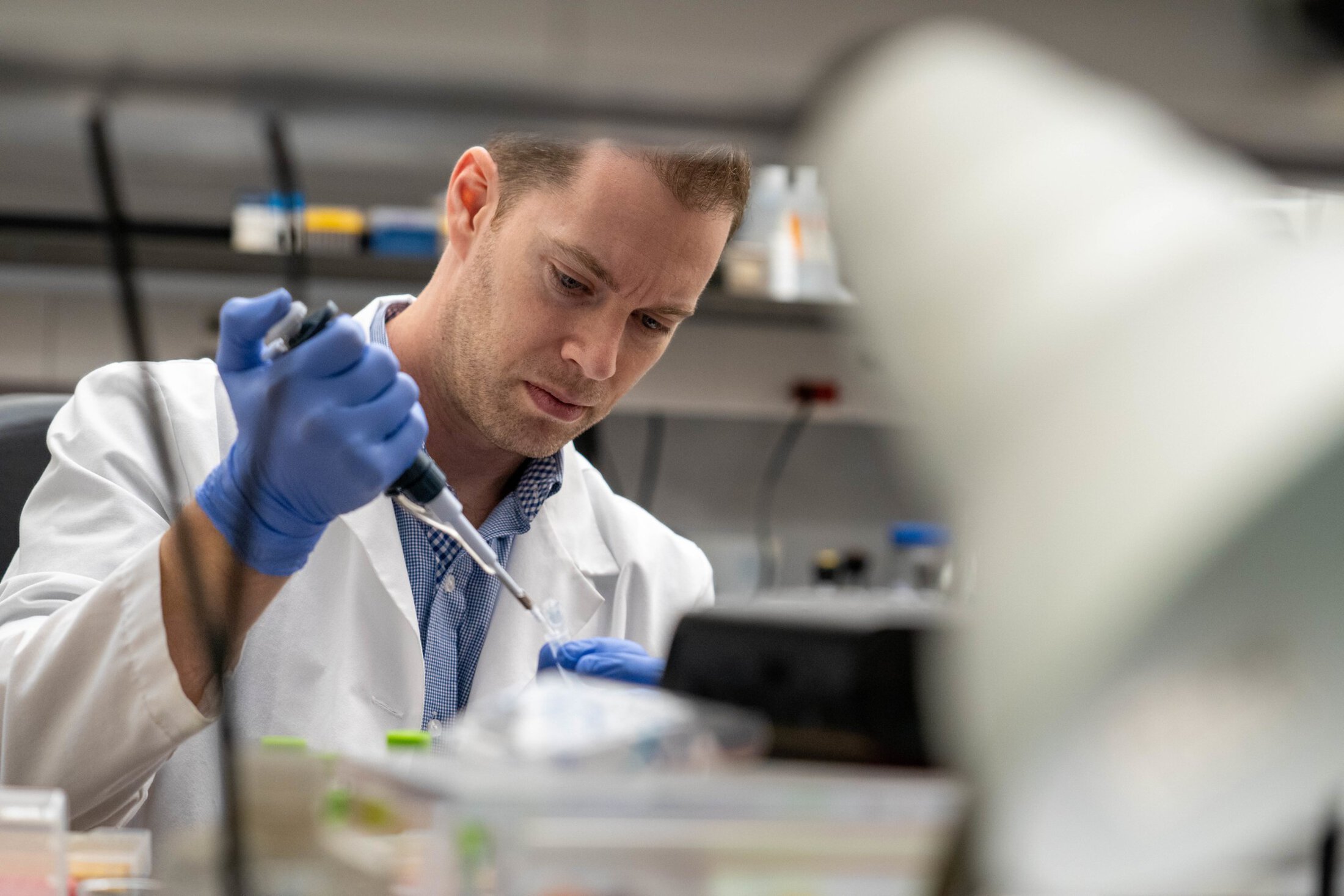
With support from an ACS Research Scholar Grant, Hollings researcher David Long, Ph.D., is studying a protein called BRD4 that helps to control how those instructions are read – and what happens when that system breaks down.
The ACS grant provides four years of funding to support Long and his team as they investigate how BRD4 is regulated and how its dysfunction contributes to cancer growth.
For Long, the award represents a continuation of support from the ACS, which funded an earlier stage of this work last year and is now helping to expand it.
“The American Cancer Society supports scientists at many different stages, and that continuity matters,” he said. “It allows us to build on earlier work and grow a project over time, rather than starting from scratch, which is critical for making real progress.”
Ultimately, the goal is to translate these insights into new ways to prevent and treat cancer.
A protein that helps to control DNA activity
Inside every cell, DNA is tightly packaged around proteins called histones. To access genetic information, cells must carefully open and close that packaging at the right time.
BRD4 plays a key role in that process by acting as a molecular “reader” that scans the DNA landscape and helps to control when genes are turned on or off.
“DNA is essentially the cell’s instruction manual,” Long explained. “If those instructions get disrupted or misread, cells can start behaving abnormally, and that leads to cancer.”
BRD4 is known for its role in activating genes that promote cell growth. But newer research, including work from Long’s lab, shows that it is also critical for repairing damaged DNA.
That dual role creates a delicate balance: Cells must coordinate when BRD4 turns genes on and when it steps aside to allow DNA repair processes to take over. Long’s research focuses on how cells maintain that balance and what happens when the system fails.
How excess BRD4 drives ovarian cancer
Long’s team has identified a key mechanism that regulates BRD4. When DNA damage occurs, another protein called ATM adds a chemical “tag” to BRD4, signaling it to rapidly detach from DNA and clear the way for repair processes to begin.
“It’s the cell’s way of saying, ‘Stop what you’re doing and move out of the way; we need to fix this.’”
If BRD4 does not separate from DNA when it should, gene activity and DNA repair can interfere with each other. The resulting conflict can create additional damage and increase genomic instability – a hallmark of cancer. That instability can quickly snowball, driving more mutations and more aggressive cancer behavior.
Even though this is early-stage work, everything we’re doing is aimed at improving outcomes for patients. Understanding these mechanisms is the first step toward making that possible.
This breakdown may be especially critical in ovarian cancer, where BRD4 is often overproduced.
The project focuses on a common and aggressive form of ovarian cancer, where cells often produce too much of the BRD4 protein, making it harder to control when it attaches to and detaches from DNA. In almost 20% of these cancers, elevated BRD4 levels are linked to faster tumor growth, greater treatment resistance and worse patient outcomes.
“When you have too much BRD4, it may not come off the DNA when it’s supposed to,” Long said. “That can lead to conflicts in the cell that contribute to cancer development.”
To understand how these processes play out in ovarian cancer, Long is collaborating with Hollings researcher Joe Delaney, Ph.D. Together, they are studying how BRD4 behaves in ovarian cancer cells and how those changes influence tumor growth and treatment response. Their partnership connects laboratory discoveries about DNA regulation to the complex biology of cancer in patients.
From basic science to future therapies
By studying how BRD4 behaves in ovarian cancer cells, including how mutations alter its function, the team hopes to understand more fully how genomic instability takes hold.
This work is discovery science, focused on uncovering the fundamental biology that drives cancer. But those early insights can lay the groundwork for future advances in patient care.
Drugs that target BRD4 and ATM already exist, but they can be limited by side effects or by cancer becoming resistant to them. Understanding how these proteins interact and are controlled could help researchers to design more precise therapies, such as combination approaches that better target cancer cells while reducing harm to healthy tissue.
“Our goal is to understand the underlying biology well enough that we can identify better strategies for treatment,” Long said.
The findings could also point to specific genetic changes that signal cancer risk or treatment response, giving doctors more precise information to tailor care.
“Even though this is early-stage work, everything we’re doing is aimed at improving outcomes for patients,” Long concluded. “Understanding these mechanisms is the first step toward making that possible.”
Featured in this story
Joe Delaney, Ph.D.
Dr. Delaney studies the impact of monoallelic alterations to cell biology. His lab’s focus is the investigation of cellular biology causally driven by copy-number alterations (CNA) in cancer cells. Ovarian cancer is a uniquely applicable and challenging model for systems biology and genetics due to the prevalence of 1,000+ gene-level CNAs (16,000 on average per tumor). While ovarian cancer has amongst the most CNAs of any cancer, these alterations are present in all solid tumors, with the median solid tumor having 39% of its genome altered by CNAs. These alterations are present in tumors without any other means of targeted therapy: no mutations in oncogenes or targetable tumor suppressor losses.
His research discovered allelic losses of autophagy to be important for ovarian cancer oncogenesis via impairment of chromosome homeostasis and developed drug strategies to target this system, which outperformed chemotherapy. Metallothionein proteins, small chelators of heavy metals and zinc ions, are a major new focus of the lab. Overall, the Delaney Lab investigates how copy-number alterations alter the biology of mammalian cells and how those changes lead to oncogenic phenotypes and treatment vulnerabilities.

David Long, Ph.D.
David Long, Ph.D., is the director of graduate training for the Department of Biochemistry & Molecular Biology and associate director of the Integrative Training in Oncogenic Signaling (ITOS) T32 program. As assistant director of cancer research and mentored training for Hollings Cancer Center, Dr. Long focuses on faculty mentorship, graduate and early-career development, and academic training programs.

Hayley Kamin
Communications Manager
Hayley Kamin is the communications manager for the Hollings Cancer Center Communications and Marketing team, having joined the team in 2025 after three years as a communications specialist at the National Institutes of Health (NIH). As a science communicator with a Ph.D. from the University of Florida, she has extensive experience translating complex research into clear, engaging content. Her career has included roles at the NIH’s National Institute of Mental Health and the American Psychological Association, where she led content development and editorial strategy, developed science and health communications and worked with researchers and clinicians to strengthen public understanding of research.
Contact Hayley at kamin@musc.edu.
Recent Gynecologic Cancer Research stories