Cachexia is a cancer-related syndrome marked by involuntary, excessive weight loss caused by the breakdown of muscle and fat. Affecting up to half of all cancer patients, it can leave people too weak to tolerate treatment.
For people with pancreatic cancer, cachexia is not a rare complication – it is often a defining feature of the disease. Long before symptoms are obvious, they can begin losing weight and strength at an alarming rate. Even when treatment is available, their body may no longer be strong enough to endure it.
Researchers at MUSC Hollings Cancer Center are working to stop that devastating process. With support from an All-Star Translational Research Award from the V Foundation, a nonprofit that funds innovative cancer studies, Denis Guttridge, Ph.D., associate director of translational science at Hollings and director of the Darby Children’s Research Institute, is leading research to understand how pancreatic tumors trigger muscle loss and how to interrupt that signal.
The competitive five-year grant is designed to accelerate discoveries from the lab to clinical trials, supporting research with a clear path to testing in patients. Building on early findings, Guttridge aims to more fully define the mechanisms underlying cachexia and translate those insights into strategies that help patients to better tolerate treatment, recover from cancer and regain strength while improving their overall quality of life.
A team effort toward progress
The work reflects a broader effort at Hollings to accelerate progress against pancreatic cancer. Guttridge co-leads, along with William Hawkins, M.D., the center’s Pancreatic Transdisciplinary Cancer Team, one of several collaborative teams where researchers, clinicians and specialists work together to tackle specific cancers. For Guttridge, that collaboration is essential to advancing projects like this, which depend on both laboratory insight and clinical expertise.
“It really is a team effort throughout the research pipeline,” he emphasized. “This award gives us the resources to move the project forward, generate data and take the next step toward clinical trials.”
Ultimately, Guttridge said, the goal is not just scientific discovery but meaningful progress for patients facing a difficult diagnosis.
“I’d like to see a win,” he said. “If we can make a difference for even a subset of pancreatic cancer patients, that’s where we start – and then we build from there.”
Looking beyond the tumor
Most cancer research has focused on the tumor itself and the cells, tissues and blood vessels immediately surrounding it, known as the microenvironment. Guttridge and his team are taking a wider view, instead studying the “macroenvironment” of pancreatic cancer, or how the disease reshapes the entire body, including distant tissues like muscles.
“Pancreatic cancer doesn’t just stay in one place – it affects the entire body,” he explained. “We’re trying to understand how the tumor interacts with broader tissues and how those interactions drive muscle loss and disease progression.”
Pancreatic cancer is highly metabolically demanding. It requires large amounts of energy, and in many patients, it pulls that energy from skeletal muscle protein. As muscle protein is broken down to amino acids and sugars to fuel the tumor’s growth, patients become weaker, making it harder to recover from surgery or tolerate treatments like chemotherapy.
Researchers have long known that inflammation – the body’s response to injury or disease – plays a key role in this process. In pancreatic cancer, that response can become overactive, sending signals that contribute to the breakdown of muscle and loss of strength seen in cachexia.
But not all inflammatory signals behave the same way. With modern tools, researchers can now see interactions that previously went undetected, revealing a more complex picture of how pancreatic cancer drives muscle loss.
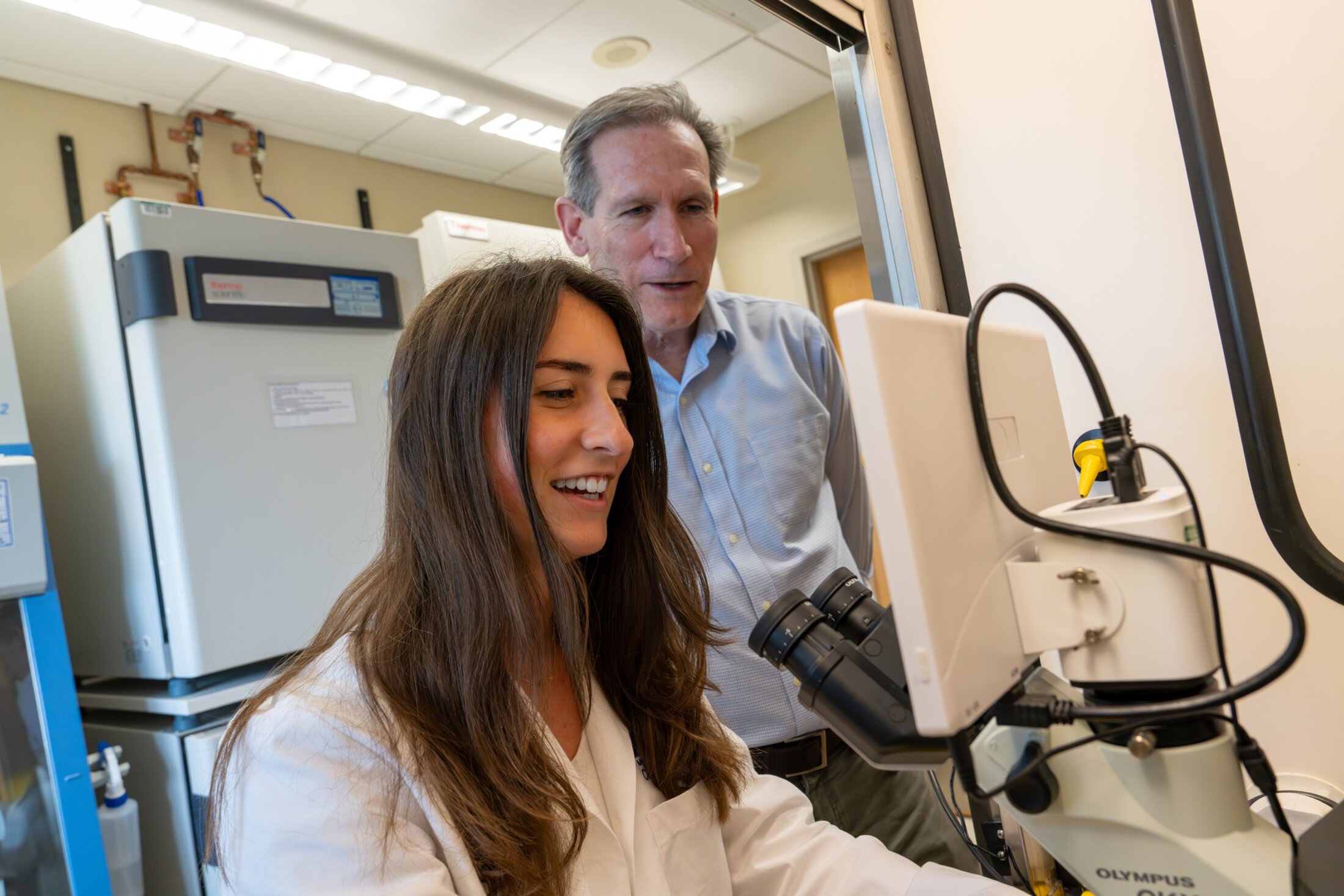
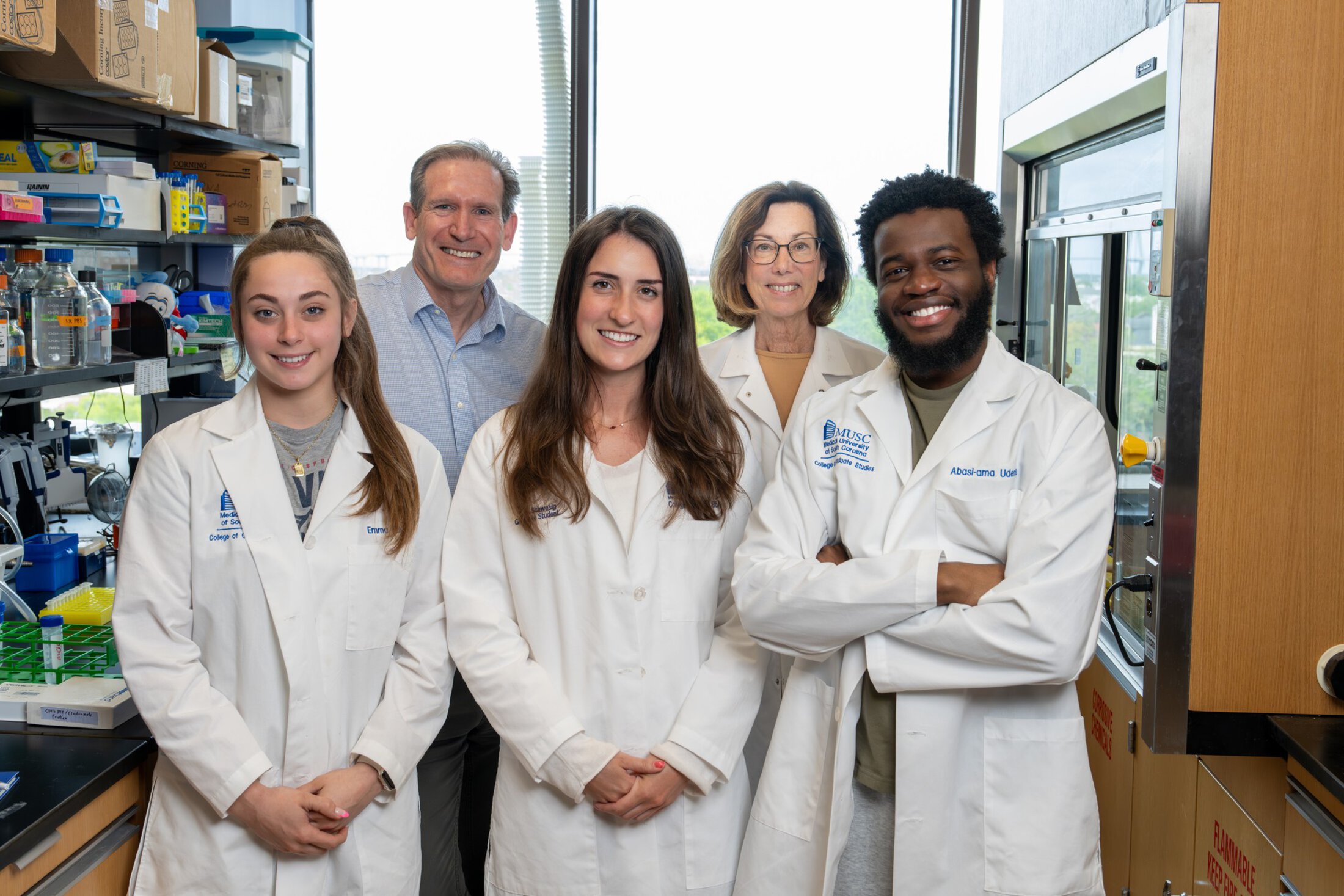
Guttridge’s team, led by graduate student Jenna Schwesig and research assistant professor David Wang, M.D., Ph.D., is focusing on a specific inflammatory pathway involving a molecule called interleukin-1 (IL-1), a signal the body uses to regulate inflammation. Although IL-1 has long been studied, its role in regulating muscle loss in cancer is not well understood. In both patient samples and laboratory models, the researchers identified signals of IL-1 activity, suggesting it may be a key contributor to bodywide muscle loss in pancreatic cancer.
“We now have a different way of thinking about how this inflammatory factor functions,” Guttridge said. “New technologies are revealing interactions we couldn’t see before – multiple cells in muscles communicating with each other and with the tumor. And that’s helping us identify new opportunities to intervene.”
From muscle to medicine
To understand how those signals lead to muscle breakdown, the researchers are taking a closer look inside the muscle itself.
Muscle is often thought of as a single tissue. In reality, it is a complex network of immune cells, blood vessels and support cells, all communicating with each other and, importantly, with signals coming from tumors. But in pancreatic cancer, those signals can become distorted, setting off a cascade that drives muscle loss.
New technologies are revealing interactions we couldn’t see before – multiple cells in muscles communicating with each other and with the tumor. And that’s helping us identify new opportunities to intervene.
Guttridge’s team is studying how pathways like IL-1 carry those signals into muscle – a kind of biological “crosstalk” that triggers muscle breakdown. By identifying the cells involved and how they respond, they hope to interrupt that message before it leads to irreversible loss.
What makes this work especially powerful is its direct connection to patient care.
At Hollings, surgeons already collect muscle samples from patients undergoing pancreatic tumor surgery. Those samples allow the researchers to confirm that what they see in the lab reflects what is happening in actual patients. Guttridge collaborates closely with oncology surgeons at Hollings, including Hawkins and Kevin Roggin, M.D., whose work in tumor resection makes collecting these samples possible.
“If we don’t see it in the patient, we can’t trust our mouse models,” Guttridge said.
So far, what they are seeing aligns: The same IL-1 signals appear in both human samples and experimental models, strengthening the case that this pathway plays a meaningful role in disease.
Early clinical observations add to that promise. As Guttridge’s team at Hollings leads efforts to understand how the IL-1 pathway drives muscle loss, collaborators at Perlmutter Cancer Center at NYU Langone Health, including medical oncologist Paul Oberstein, M.D., and researcher Peter Yu, M.D., have contributed patient data showing stabilized weight and preserved muscle in patients receiving therapies that target the pathway.
That combination of biological insight and clinical evidence is helping to move the research closer to patient care. Because therapies targeting this pathway are already in development, the road to clinical trials may be shorter than with traditional approaches.
The urgency is clear. Pancreatic cancer remains one of the deadliest cancers, with low long-term survival rates. Even patients eligible for surgery often experience significant muscle loss. That loss can slow recovery and limit their ability to receive further treatment.
Guttridge hopes that addressing cachexia could begin to change that – not just by treating the cancer but by helping patients to stay strong enough to withstand it.
“If we can treat patients earlier, preserve their muscle and help them recover better from surgery, that could put them in a much better position for the next steps in their treatment and improve their long-term outcomes.”
Featured in this story
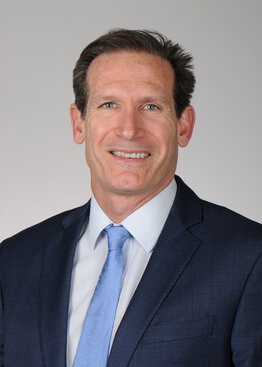
Denis C. Guttridge, Ph.D.
Denis C. Guttridge, Ph.D., joined MUSC in 2018 as the Hollings Cancer Center associate director of translational science and the director of the Charles P. Darby Children’s Research Institute. Guttridge holds a robust research funding portfolio and has authored more than 130 peer-reviewed publications. He has received numerous recognitions for his contributions to cancer research and his dedication to fostering multidisciplinary and collaborative science.

Hayley Kamin
Communications Manager
Hayley Kamin is the communications manager for the Hollings Cancer Center Communications and Marketing team, having joined the team in 2025 after three years as a communications specialist at the National Institutes of Health (NIH). As a science communicator with a Ph.D. from the University of Florida, she has extensive experience translating complex research into clear, engaging content. Her career has included roles at the NIH’s National Institute of Mental Health and the American Psychological Association, where she led content development and editorial strategy, developed science and health communications and worked with researchers and clinicians to strengthen public understanding of research.
Contact Hayley at kamin@musc.edu.
Recent Cancer Research stories