Sometimes improving care for patients means offering the latest drug or procedure.
Sometimes it means sitting down with a color-coded clinic schedule and reimagining what’s been in place for as long as anyone can remember.
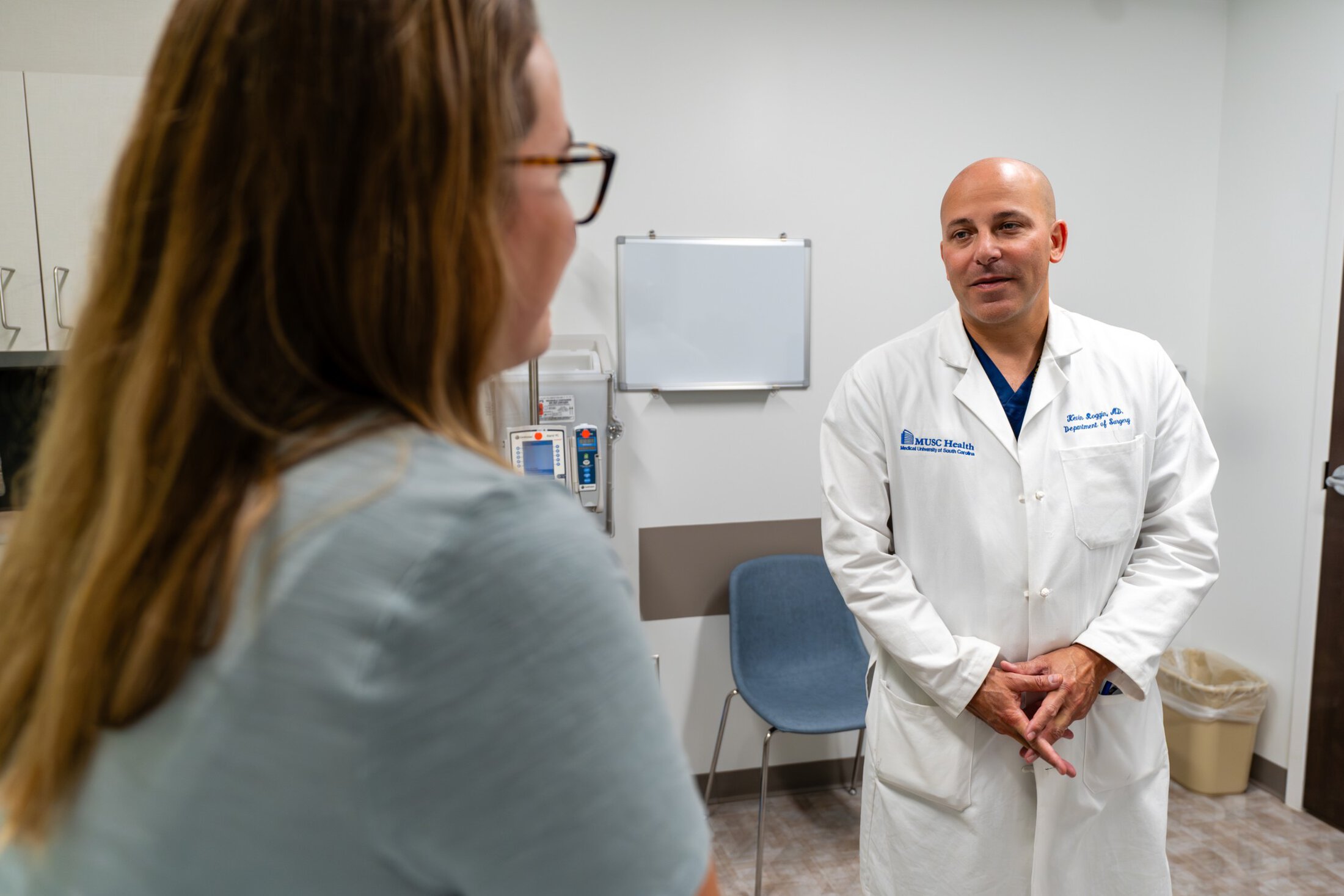
The latter is the approach that surgical oncology chief Kevin Roggin, M.D., took toward improving access for patients with hepato-pancreato-biliary and other abdominal cancers at MUSC Hollings Cancer Center.
Now, after a year of implementing a new approach to scheduling patients, the clinic is seeing improvements in access – and other clinics within Hollings are taking notice.
Improving timely access to surgeons
Hepato-pancreato-biliary (HPB) cancers include liver cancer, pancreatic cancer and gallbladder and bile duct cancer. Other cancers included in the new Next-Day Access (NDA) program include gastric cancer, small bowel cancer and retroperitoneal sarcomas. Often, these cancers don’t cause symptoms in early stages, and there aren’t reliable screening tests that can be used on a widespread basis. Because these cancers are often diagnosed in later stages, getting fast access to a specialist is important – both to get the treatment plan started and for the patient’s peace of mind.
The goal of the Next-Day Access program is to give eligible patients the option to schedule an appointment within 48 hours.
Sydney Waterhouse, R.N., worked in the HPB cancers program both before and after the Next-Day Access program was implemented. She’s noticed that patients are surprised and appreciative that they can schedule quickly. It gives them a sense of control in an unnerving time, she said.
It's given patients a lot of flexibility, which I think also makes them feel like they don't have to rearrange every single little part of their lives because that might be the only chance that they get to see a surgeon. We're able to accommodate them, with whatever works for them.
“If they're not able to get to us the next day, we offer to schedule the appointment at their convenience, like any time that they can get a ride. So it's given patients a lot of flexibility, which I think also makes them feel like they don't have to rearrange every single little part of their lives because that might be the only chance that they get to see a surgeon. We're able to accommodate them, with whatever works for them,” she explained.
Under the old system, the HPB team was in clinic one day per week. The Hollings clinics – a finite number of exam rooms that must accommodate an ever-growing number of patients – followed a block system of scheduling. The lung team was scheduled in one block, the breast team in another, and so on. The HPB block was on Wednesdays.
Having a team in clinic all together creates a synergy and encourages collaboration. But for HPB patients, it also meant waiting up to a week for the first visit, depending on when they called. Then there could be further waits for biopsies, additional imaging studies or the gathering of records.
When Roggin arrived at Hollings, the first task handed to him was to improve this timeline.
He set a goal that HPB and abdominal cancer patients should be able to see a provider on the next business day, if they wanted to.
To accomplish this, the clinic schedule was revamped. A surgical oncology advanced practice provider was scheduled every day to conduct the first intake appointment. A nurse navigator and genetic counselor were also on hand. The surgeons’ schedules had to be reorganized so one would always be available to drop in and meet the patient.
Courtney Pittman, R.N., care coordinator with the NDA program, noted that other teams had to be looped in as well.
“The imaging department – CT, MRI – you have to have everybody on board,” she said.
In addition, the referral process had to be reworked so that referrals made through the electronic health record would be routed to a new, dedicated phone line, which would be answered by a single, experienced nurse rather than a rotation of junior staff members.
Kelsey Cook, R.N., is that first point of contact and serves as program manager for NDA. With her longtime experience in the area, she can triage the calls to ensure that those who are eligible are offered a next-day appointment and that calls for other concerns are routed to the correct intake lines. To be eligible for NDA, patients must be diagnosed with, or have a suspicion of, an HPB or abdominal cancer, but it cannot have metastasized.
She’s enthusiastic about the access that the initiative offers patients.
“A lot of the patients from the smaller, more rural counties of South Carolina are seen by physicians who are not specialty trained to treat HPB cancer or abdominal cancer,” she said. “And so a lot of referrals that we get, the doctor will have seen a mass on a CT. So we get the patient in quickly to start the work-up, to get a biopsy and to expedite their care that otherwise could take weeks or months if they stayed local.”
A lot of people like the video visits because they live so far away. Especially if they need transportation. And then they can also have multiple family members with them on the call.
Not every patient could take a next-day appointment.
“A lot of patients in our population are older, and they live in cities and counties throughout the state, and oftentimes, 48 hours may be too soon for them, especially if they have to arrange a ride with a child or a neighbor,” Cook said.
Some patients might prefer to wait until additional imaging is completed and the results are back.
However, the surgeons in the program can conduct a video visit to establish care and get the process started.
“A lot of people like the video visits because they live so far away,” Cook noted. “Especially if they need transportation. And then they can also have multiple family members with them on the call. I definitely think it's expanded access, particularly for patients who want to self-refer. They find our phone number and call me, and we're able to get them in."
Enhanced focus achieved faster appointments
When Roggin and his team analyzed the first year of the new scheduling program, they found a remarkable improvement in how quickly patients were seen.The median time from phone call to first appointment was two days for people who were routed through the Next-Day Access program, compared with seven days for people who were scheduled through the standard route.
The focus of the first appointment will differ for each patient, depending on what is known. Some people, for example, might be referred because a doctor saw a suspicious spot on a scan. Others will already have a diagnosis. Waterhouse explained that in either case, the patient will come out of the appointment with a plan.
"They'll have a plan no matter what. If that's additional imaging and workup, or if that's surgery, or if that's chemotherapy – it just gives them some answers and a path that they're going to follow," she said.
The initial access improvement project was small – there are far fewer HPB and abdominal cancer patients than there are breast cancer or lung cancer patients, for example. But the positive results have caught the eye of leaders throughout the cancer center, who are eager to improve access for all patients.
The breast cancer and endocrine cancer teams are now in the process of adapting the NDA template for their patients.
But improving access is just the first step toward improving care, Roggin noted. Even as his team continues to gather data, they plan to add two more surgeons by the end of the year and address other bottlenecks in the system.
“The challenge now lies in expanding this program to all other cancers and sustaining our current growth,” Roggin said.
Leslie Cantu
Senior Communications Manager
Leslie Cantu is the senior communications manager at MUSC Hollings Cancer Center, where she works with researchers, clinicians and patients to tell the people of South Carolina about the innovative work being done to improve cancer care for everyone in the state. She joined the MUSC Office of Communications and Marketing in 2018 after a career as an award-winning writer, editor and producer at community newspapers and local TV news. She transferred to the communications office at Hollings in 2022, where she happily finds something new and interesting to write about every day. Her favorite stories to cover at MUSC have included Match Day, the Angel Tree Parade, a clinical trial of CAR-T cell therapy and the many patients who have agreed to share their very personal struggles and triumphs.
Contact Leslie at cantul@musc.edu.
Recent Cancer Care stories