I guess you could say that after I dealt with it myself, I realized the importance of getting screening done. If I can help somebody else and save them from what I went through, then it's worth it.



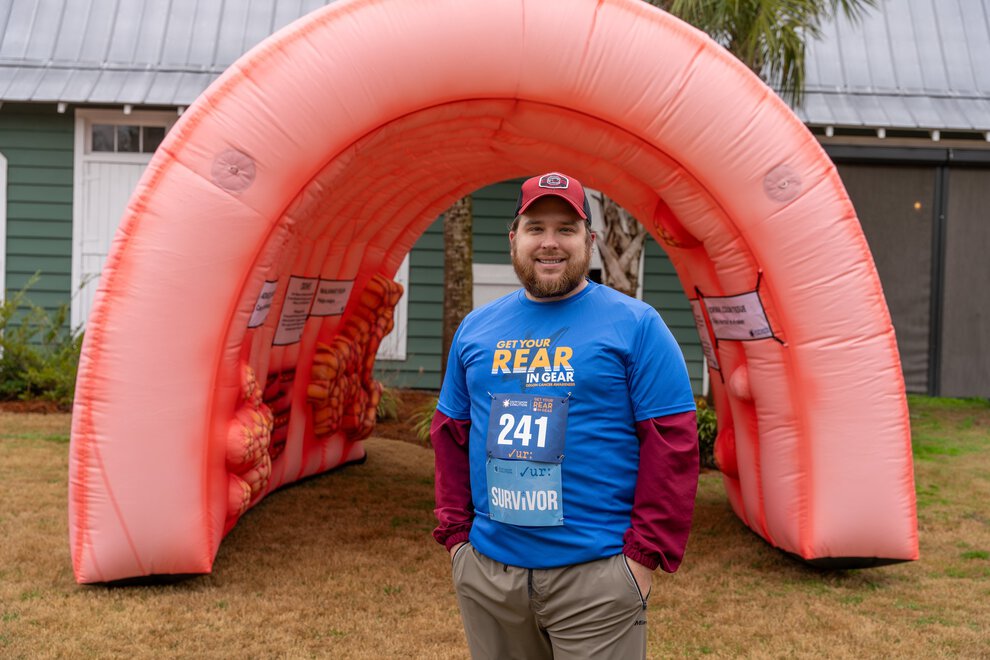
Colon cancer and rectal cancer — together called colorectal cancer — are the third most common cancer in both men and women in South Carolina. MUSC Hollings Cancer Center is committed to providing the best possible care while researching better ways for prevention, diagnosis and treatment of this cancer.
Hollings has been accredited by the American College of Surgeons' National Accreditation Program for Rectal Cancer (NAPRC) since 2021. We are one of a select group of cancer centers — and the first in South Carolina — to earn this distinction. In addition, University Medical Center, the hospital where our surgeons operate, has been consistently named as a high-performing hospital for colon cancer surgery.
MUSC Hollings Cancer Center has been recognized as High Performing in Colon Cancer Surgery in the 2025–2026 U.S. News & World Report rankings. This distinction reflects our expertise in complex colon cancer procedures and commitment to better outcomes for patients across South Carolina.

Colorectal cancer is cancer in the large intestine. In recent years, scientists have started to distinguish between colon cancer and rectal cancer because they may have different causes and need different treatments, but they are still often referred to together as colorectal cancer. Colon cancer happens in the colon, or the five feet that is the main part of the large intestine. Rectal cancer happens in the rectum, the last six inches before the anal canal.
Have more questions about colorectal cancer? Check out our answers to common questions.
When detected and treated early, colon cancer is usually curable. Screening for colon cancer is recommended for anyone over the age of 45. If you have a family history of colon cancer or are at an increased risk, talk to your doctor about starting screening at age 40 or younger.
Symptoms of colorectal cancer could also be symptoms of other diseases or conditions. But it’s important to talk to your doctor so that you can rule out cancer — or so you can begin treatment as soon as possible. Symptoms of colorectal cancer can include:
It’s especially important to discuss these symptoms with your doctor if you are under the age of 50. More cases of early-onset colon cancer are happening. Researchers have found that young adults who have three of these symptoms — abdominal pain, rectal bleeding, diarrhea or iron-deficiency anemia — are more likely to be diagnosed with colon cancer.
I guess you could say that after I dealt with it myself, I realized the importance of getting screening done. If I can help somebody else and save them from what I went through, then it's worth it.
Treatment of colorectal cancer can involve surgery, chemotherapy, radiation, immunotherapy, targeted therapy or a combination of multiple therapies. Your doctor will talk to you about the best options that fit your situation.
The main treatment for colon cancer is surgical removal of the tumor by removing a section of the colon that includes the tumor and healthy bowel on either side.
In the past, many operations involved the formation of a colostomy, which meant wearing a bag on the abdominal wall to collect bowel movements. Fortunately, surgery has progressed significantly in recent decades, and now only rarely involves creation of a colostomy.
Most operations are now performed minimally invasively using laparoscopy or a surgical robot. These approaches use small incisions in the abdomen to introduce a camera and surgical instruments to conduct the operation without the need for a large incision. Minimally invasive techniques have been shown to help patients recover more quickly and with less pain.
Chemotherapy or radiation therapy may be recommended before surgery to shrink the tumor. After surgery, the need for chemotherapy, targeted therapy or immunotherapy is decided primarily on the basis of whether the cancer has spread to the lymph nodes.
Patients with locally advanced rectal cancer are recommended to proceed with total neoadjuvant therapy (TNT). This means patients receive both chemotherapy and radiation prior to surgery in an effort to shrink the tumor and, in some cases, treat the tumor completely.
By giving patients chemotherapy and radiation before surgery, the multidisciplinary team at Hollings has seen a complete clinical response rate (no evidence of cancer) in up to 40% of patients. This group of patients who have a complete clinical response following TNT may not require surgery at all.
However, patients who show a complete clinical response do require monitoring with MRI and sigmoidoscopy every three months for three years to ensure there are no signs of the disease returning. This non-operative “watch and wait” approach depends on close adherence to the surveillance regimen to detect tumor regrowth early, if it occurs. With early detection, patients can still be treated with curative intent surgery.
In cases in which the tumor is still present after TNT, the next step will depend on the stage of the cancer and tumor location within the rectum.
Local excision: For small stage I rectal cancers that are less than 3 centimeters in size, removal of the tumor through the anal canal with preservation of the rectum may be considered.
Low anterior resection with anastomosis involves removing the portion of the rectum where the tumor is located, including the fatty tissue that surrounds the rectum (mesorectum) and houses the lymph nodes. A new connection is made between the colon and lower rectum. This may require a temporary diverting ostomy to allow the new connection to heal completely.
Abdominoperineal resection is generally reserved for tumors invading the anal sphincter muscles. This procedure requires removal of the anal canal and sphincter muscles in addition to the rectum with creation of a permanent colostomy. This may be considered in patients with advanced tumors involving the sphincter muscle or patients with pre-existing incontinence that may prefer a colostomy.
At Hollings, the surgical procedures above are most commonly performed minimally invasively (i.e., with small incisions), which permits a faster recovery and improved quality of life. These approaches include:
In all therapies, the goal of the Hollings team is to treat the cancer and also to avoid post-surgical complications, avoid the need for a colostomy, and maximize your quality of life.
It is important to remember that treatment for rectal cancer is individualized and must consider both the stage and location of the tumor. The team also considers your values and goals as the patient, taking into consideration your current bowel function, social support and network.
Establishing an individualized treatment plan is a dialogue between you and the surgeon in which the surgeon helps to explain the rationale for each treatment and the potential outcomes to allow you to make an informed decision and take ownership over your cancer care.
Physicians: to refer a colorectal cancer patient to Hollings, please call 843-985-0594.
Our gastrointestinal cancer nurse navigators, Sara Sneed, BSN, RN, OCN, ONN-CG (sneedsa@musc.edu), at our Charleston-area locations and Elizabeth Powell, BSN, RN, OCN (powelle@musc.edu), at our Midlands locations, will help you understand what to expect during treatment and answer questions you may have.
Contact us at 843-792-9300 to make an appointment with one of our colon and rectal cancer specialists.
Clinical trials are how we know which treatments work; results from clinical trials determine what becomes the standard of care across cancer centers. As a National Cancer Institute-designated cancer center, Hollings takes an active part in clinical trials to continue advancing knowledge of cancer care.
Why might you participate in a clinical trial?
First, there are different types of trials. Some test a new medication. Some might look at whether the order of treatments (surgery, chemotherapy, radiation) makes a difference. Others look at ways to improve quality of life. Your doctor may suggest a clinical trial believing that you could benefit from it. Because therapies in clinical trials have the potential to become the standard of care in the future, you could possibly have earlier access to a new treatment. You will also be helping future cancer patients, who will benefit from the information created during the trial. In some clinical trials you will receive at least the standard of care, and possibly something extra, while in others you will receive a new drug that is being tested in your type of cancer. Your doctor and the research team will help to guide you.
Our clinical trials page includes more information about trials as well as some questions for you to ask if you are considering a trial. You can also review our current colorectal cancer clinical trials and gastrointestinal cancer clinical trials.
Our team of doctors and researchers are focused on identifying causes of this cancer, which has started to appear in younger populations, and the best care options. Some of the research happening here includes:
In addition, Hollings’ dedicated Colon Transdisciplinary Cancer Team brings together expertise from different disciplines in basic and clinical research for monthly meetings to collaborate on ongoing colorectal cancer research.


Risk factors increase your risk of getting cancer — they do not mean that you will automatically get cancer, and they do not mean that people without these risk factors won’t get cancer. Some risk factors are unchangeable, like getting older. But some lifestyle risk factors can be changed.
Some of these lifestyle risk factors apply to many different types of diseases, so taking action to reduce your risk of colorectal cancer could also reduce your risk of other diseases.
MUSC Health’s Tobacco Treatment Program provides education and cessation resources for South Carolina.
Learn about how programs offered by the Weight Management Center can help you or your loved ones reach weight loss goals.
The genetic counseling team and Hereditary Cancer Clinic at Hollings can help you assess and manage your cancer risk.
Screening means looking for cancer before you have any symptoms, and it’s one of the most important things you can do to reduce your cancer risk.
Colorectal cancer usually takes years to develop, which gives us the opportunity to intervene when it’s still in pre-cancerous form. To do that, everyone 45 years and older who is at average risk should get regular colon cancer screening. If you are at higher risk because of a family history or your own history of cancer, talk to your doctor about whether to begin screening before age 45.
A colonoscopy allows the doctor to see and remove polyps in your colon that could develop into cancer.
Other types of screening tests, like at-home fecal screening tests, will pick up on changes in your cells or find microscopic amounts of blood. If these tests find something, you will often need to follow up with a colonoscopy.
Have you or a loved one received a diagnosis of colorectal cancer? You probably have a lot of questions. There’s a lot of information to take in after a cancer diagnosis. Your doctor can answer questions specific to your care, but we have compiled a list of some of the most common questions for your reference below.
Some genetic mutations that can cause colon cancer can be passed down through families. If you know that you have an inherited genetic mutation that increases the chances of colon cancer, or if you are interested in genetic testing because of a strong history of cancer in your family, we recommend working with the Hollings Hereditary Cancer Clinic.
However, most people who are diagnosed with colon cancer don’t have any inherited genetic conditions.
Treating colon cancer depends on its stage and location. There are multiple treatments, and your doctor will discuss your options with you.
Exercise, eat a healthy diet with lots of whole grains, fruits and vegetables and little red meat or processed meat, stop smoking, maintain a healthy weight, and watch how much alcohol you drink.
HPV does not cause rectal cancer. HPV causes anal cancer, which is a different type of cancer.