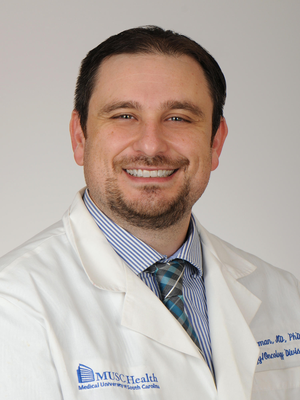
Jaya Sai Chavali, M.D., MBBS
Specialties
- Urology
- Bladder Cancer
- Kidney Cancer
- Prostate Cancer
- Testicular Cancer
Locations (3)
- Charleston, SC
- Mount Pleasant, SC
- Orangeburg, SC


Prostate cancer is the most diagnosed cancer in men, aside from skin cancer. It is also highly treatable, especially when caught early. Many prostate cancers grow slowly and may never cause symptoms or affect lifespan, and they can be monitored rather than treated. Others can be more aggressive and require prompt treatment. Early detection and personalized care are key to achieving the best outcomes.
At MUSC Hollings Cancer Center, you’ll be cared for by a multidisciplinary team of medical, surgical, and radiation oncologists, radiologists, pathologists, genetic counselors and nurse navigators who work together to help you through diagnosis, treatment and recovery.

Hollings Cancer Center is recognized as High Performing in Prostate Cancer Surgery in the 2026–2027 U.S. News & World Report Best Hospitals rankings. This distinction highlights our commitment to delivering advanced, outcome-driven surgical care for patients with prostate and genitourinary cancers.
The prostate is a small gland, about the size and shape of a walnut, that is part of the male reproductive system. It sits deep inside the pelvis, right below the bladder and in front of the rectum. As men age, it is normal for this gland to grow slightly larger.
Prostate cancer develops when cells in the prostate grow out of control. These abnormal cells do not die when they should and become prostate cancer as a result.
Most prostate cancers are adenocarcinomas, which begin in the gland cells of the prostate that produce fluid. In rare cases, prostate cancer can develop in other types of cells.
A distinctive feature of prostate cancer is that it is often – though not always – slow-growing. Many men have what doctors call "indolent" cancer, meaning it grows so slowly that it may never cause symptoms or affect life expectancy.
However, some prostate cancers are more aggressive. These types can grow quickly and spread to other parts of the body, such as the bones or lymph nodes. Determining whether a prostate cancer is slow-growing or aggressive is a key goal of testing and diagnosis.
Prostate cancer often does not cause symptoms early on, and many men with the cancer feel completely fine when it is first detected. That is why screening matters.
When symptoms do appear, they are usually related to urination or, in more advanced cases, to pain or other body-wide effects.
Common symptoms include:
Other possible symptoms include:
If you experience any of these symptoms, talk with a healthcare provider. They can determine whether your symptoms are caused by a common, noncancerous condition or a condition that needs further evaluation. It is especially important to seek care if you are over age 50, over age 45 with risk factors or have a family history of prostate cancer.


Our specialists work together to develop a treatment plan tailored to your needs. That can include a combination of treatments, depending on the cancer’s stage, size and location, whether it has spread and your overall health.
Screening and diagnostic tests can show whether you have signs of prostate cancer that require more testing:
Active surveillance is the preferred management approach for many men with low-risk prostate cancer and some with favorable intermediate-risk prostate cancer. Patients with certain low-grade cancers and some small-volume tumors may be good candidates for this approach.
Rather than treating the cancer immediately, active surveillance involves closely monitoring it over time with regular PSA testing, imaging and, in some cases, repeat biopsies. Because many low-risk prostate cancers grow very slowly, active surveillance can help patients to avoid or delay unnecessary treatment while ensuring treatment is started if the cancer shows signs of progression.
Surgery may be used to remove the prostate, particularly for localized disease. A radical prostatectomy, which removes the diseased prostate gland, often successfully eliminates prostate cancer that has not spread. When possible, surgeons use minimally invasive techniques to reduce recovery time and side effects.
Depending on your diagnosis and treatment goals, our surgeons offer several surgical approaches to remove prostate tumors, including:
Patients who receive prostate cancer care at MUSC benefit from clinicians with expertise in all these approaches.
Traditional robotic surgery uses several robotic arms, or ports, through which surgical instruments and a camera are placed via multiple small incisions. With single-port surgery, all instruments and the camera are inserted using one robotic arm through a single incision. For appropriately selected patients, this minimally invasive approach may result in less pain, faster recovery and minimal scarring.
Focal therapy is a newer form of treatment that destroys tumors inside the prostate. A doctor may recommend this treatment if the cancer is low risk and has not spread. Many of these treatments are still considered experimental.
Cryotherapy, or cryoablation, is a treatment that uses extreme cold to destroy tissue (often via probes that freeze tumors).
It can be used in different ways:
High-intensity focused ultrasound (HIFU) uses precise, high-frequency sound waves to thermally destroy solid tumors.
NanoKnife irreversible electroporation (IRE) uses precise, high-voltage electrical pulses to create microscopic holes in cell membranes.
Radiation therapy uses targeted energy beams, such as X-rays or protons, to destroy cancer cells at specific sites in the body. The radiation is usually delivered daily over several weeks. Radiation may be used alone or in combination with other therapies like chemotherapy.
Chemotherapy uses strong medicines to attack cancer cells. Some are injected in a vein, and others come in a pill form. It is not commonly used for early-stage prostate cancer but may be recommended for advanced or metastatic disease. The specific medicines used and how often you receive them will be determined by your care team.
Androgens are male hormones that can fuel prostate cancer growth. Hormone therapy lowers testosterone levels or blocks their effects, helping slow cancer growth or shrink tumors.
Other treatment options for prostate cancer can include:
First, there are different types of trials. Some test a new medication. Some look at whether the order of treatments (surgery, chemotherapy, radiation) makes a difference. Others look at ways to improve quality of life. Your doctor may suggest a clinical trial that you could benefit from.
Because therapies in clinical trials have the potential to become the standard of care in the future, you could have earlier access to a new treatment. You will also be helping future cancer patients, who will benefit from the information learned during the trial. In some clinical trials, you will receive at least the standard of care, and possibly something extra, while in others, you will receive a new drug that is being tested in your type of cancer. Your doctor and the research team will help to guide you.
Our clinical trials page includes more information as well as some questions to ask if you are considering a trial. You can also review our current prostate cancer clinical trials.
Call 843-792-9300 to make an appointment with one of our prostate cancer specialists.





There is no single known cause of prostate cancer, but certain factors increase its risk.
These include:
Have more questions about prostate cancer? Check out our answers to common questions.
There is no sure way to prevent prostate cancer. But there are ways you can reduce your risk:
Some medications, such as finasteride (Propecia, Proscar) and dutasteride (Avodart), are associated with a reduced risk of prostate cancer, but they are not routinely recommended solely for prevention. Always talk with a healthcare provider before taking medications or supplements for risk reduction.
The prostate is a small gland, about the size of a walnut, that sits below the bladder. It is part of the male reproductive system and helps produce fluid that makes up semen.
In many cases, yes. Prostate cancer is often highly treatable, especially when it is found early and has not spread outside the prostate. Even when prostate cancer is more advanced, treatments can often control the disease for many years and help people maintain a good quality of life.
There is no guaranteed way to prevent prostate cancer. However, maintaining a healthy lifestyle, such as eating a balanced diet, staying physically active, maintaining a healthy weight, not smoking and limiting alcohol, may help reduce risk and support overall prostate health. Regular discussions with a healthcare provider about screening can also help detect prostate cancer early, when it is most treatable.
The Gleason score is a prostate cancer grading system that indicates the cancer's aggressiveness and likelihood of spreading based on how abnormal the cells appear under a microscope. Scores range from 6 (low grade) to 10 (high grade), with higher scores indicating a more aggressive cancer and a greater risk of spread.
MUSC Hollings Cancer Center radiation oncologist Dr. David Marshall explains the Gleason Score and risk levels of prostate cancer.