Hollings Cancer Patient Stories

Read inspiring stories from our cancer patients and learn why they chose to seek care from our team of experts.

Real Stories
Real Strength

In their own words, these patients share their journeys to inspire hope, compassion, and resilience.

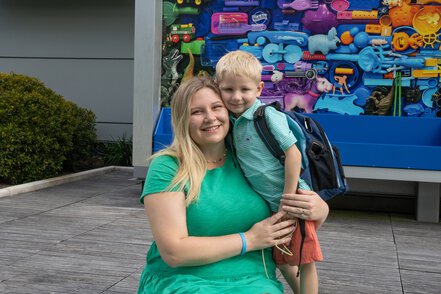
a mother and child smile happily
Fighting Strong: A little warrior’s battle with a rare cancer
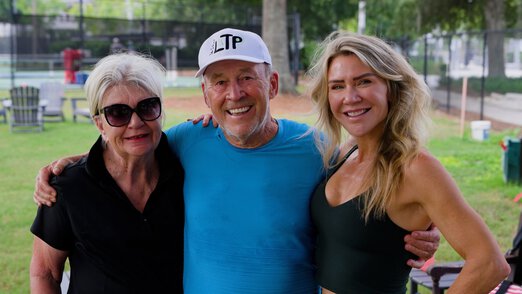
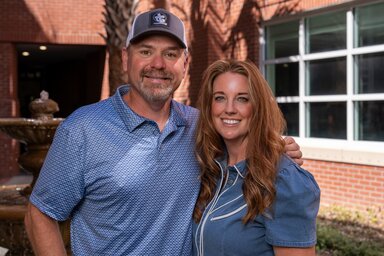
a smiling family photo at the pickleball court
Staying in the game after cancer
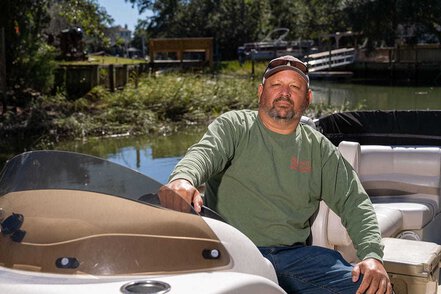
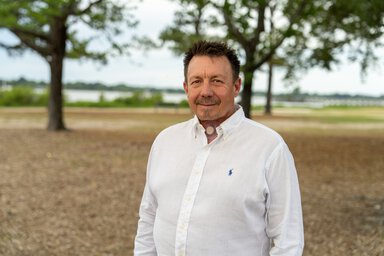
A man poses in the captain's chair of a pontoon boat docked on a creek that winds between back yards.
South Carolina strong: Fighting lung cancer
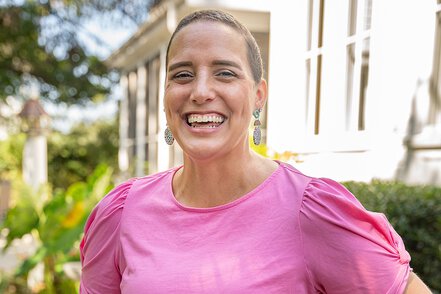
Life is precious for two-time cancer survivor

[A young woman struggles to contain a wriggly little boy in her lap as they sit in front of a stained glass window mosaic portraying a live oak]

(Allie Strong): Our world just flipped upside down, like that fast. Never expected, like, a tumor or any of that.

[Upbeat music plays over MUSC Hollings Cancer Center logo. Snapshots fill the screen of the little boy and girl with baby sister, the boy in a Halloween costume, the boy with his father on a baseball field ]

Luke is our oldest son. He likes to play outside. He likes anything boy – trucks, tractors, balls.

[Allie and Luke walk along a landscaped play area as he swings part of his medical gear like a sword]

He's really into sword fighting and reptiles right now. And he is super sweet. He's like the sweetest little boy.

[Snapshots of Luke in the hospital]

Last year on Mother's Day he was just, like, screaming in pain all night. And I was like, this is not usual. He was just saying “my belly.” So we went to the E.R.

[Screen displays: “After weeks of symptoms and two trips to the ER, doctors found that Luke had pancreatoblastoma. Pancreatoblastoma is a rare pancreatic cancer that primarily affects young children.”]

(Dr. Kevin Roggin) [Dr. Roggin sits at his desk]: I remember when we first talked about his case, it was like, I don't know how we could possibly do an operation that would effectively remove his tumor.

[Snapshots of Luke acting goofy with his IV pole, hanging out with nurses for his birthday, and laying in his hospital bed]

We kept surgery on the table as an option to see but none of us really felt like that was the best option.

And it's only after, you know, his really dedicated team of oncologists at Shawn Jenkins that kept pushing the envelope in terms of systemic therapies. And when we sort of reached a point where we felt like the tumor was as small as it was going to be and we then decided to put together a multidisciplinary team.

And together we mapped out a plan to try to remove Luke's tumor.

[Screen displays: “That plan included a Whipple procedure – a complex surgery to remove the head of the pancreas, duodenum, gallbladder and bile duct to treat the tumor. It is a rare, high-stakes surgery for children.”]

(Allie)[Allie and Luke in front of the stained glass]: I was a little nervous being that, like, Dr. Roggin is an adult, like primarily an adult [doctor]. But he has been excellent. He's, like, been top tier. Like, he was just so great with Luke. And, we're very grateful.

[Dr. Roggin in his office]: Most of our experience in this specific operation is in the adult population and in my career – over 20 something years, the range that I had operated on was 14 to 91. So Luke represents the youngest case that I've done.

[Luke and his mother play in the outdoor play area]

It's an operation that is one of the most complex operations we do in abdominal surgical oncology. I always describe it to patients as it's like kind of the Boardwalk and Park Place of the body, where it's really high-priced real estate, and there's a lot of structures that we need to preserve.

[Dr. Roggin in his office]

And in Luke's case, because he had had a longstanding tumor and blockage of the venous drainage back to his liver, in order to take out his tumor, we had to separate all those connections that his body, you know, made to return blood because it was blocked.

[Allie and Luke in front of the stained glass]

(Allie): When Dr. Roggin and Dr. Cina came and told us, “Hey, it's done. Like the tumor peeled away and we didn't have to touch the vein.” I was like, I was just astonished. I was like, “Wow, this is amazing.”

[Snapshots of Luke in the hospital, snuggling with dad and of a large group of supporters in the lobby]

(Dr. Roggin): Instead of worrying about the playground and all these other things, Luke was, you know, in and out of the hospital.

But what, you know, what struck me about him and his family is how optimistic they were, how much they were people of faith, and they had such a strong, supportive community that sort of rallied behind Luke.

[Screen displays, “The Strongs hope to take this challenge and turn it into something good.]

(Allie): We would just like to see for him to complete this oral chemo and hopefully, maybe start school next year. And to get on with life and – yeah, just...I hope that he can use this to help other people. And that's how I've looked at it is I want to be able to use our experience to help other people – other families going through stuff like this.

(Roggin): You know, Luke's a special boy, has got a special family and they obviously were dealt a very difficult hand. But what was unique about their family and their support was that they really had faith that, you know, they were in the right place and the right hands.

And it made everyone's job easier because we, we sort of felt like they understood and they were so grateful for, you know, anything that we could do to help Luke that it made it easy to work with them.

And it was a really high point for our team to go in there and, you know, see Luke at the different stages of recovery.

[Cell phone video of Luke and Dr. Roggin play sword fighting in a hospital room]

And, Luke is a sword fighter. He is – that's his thing. And so, I was able to to participate. And I will say that Luke definitely defeated his surgeon with his sword fighting skill, but it was a fun part of, you know, getting to see him. When he could get back to sword fighting, that's when I knew it was going to be better.

[MUSC Hollings Cancer Center logo]

[Music plays over MUSC Hollings Cancer Center logo]

[A man sits in an exam room and speaks to the camera]

(Jack Smith): About a year and a half ago, I had to visit, a surgeon, and the surgeon came out and said, ‘Well, here's the MRI, and it doesn't look good.

[A CT scan on a monitor]

(Jack Smith): You have one kidney that's hardly functioning, and the other one is sort of damaged. And you have this cancerous tumor connected.’ And then Doctor Lally came in and we discussed possibilities.

[Jack and Dr. Lally sit together in an exam room; Dr. Lally in his office looking at scans on multiple computer screens]

(Jack Smith): So then I met him and his associates, and his associates looked at it and said, ‘You know, we think we might be able to do something here.’

(Dr. Brian Lally, radiation oncologist): He had a small lesion consistent with a cancer on his kidney. However, he has some challenges where he only has one good kidney. And some parts of that kidney were also nonfunctional or at risk. And so what we did was we used radiation to ablate that area because it was close to the center.

Got a CT scan and we contoured out all the anatomy on that CT scan. And we then plan to deliver a high dose of radiation to just the area that was the tumor.

And that's the goal of treatment. It gives him his quality of life that way.

[Jack serves the ball on a pickleball court]

And avoids him being on dialysis immediately. He may have to at some point.

(Jack Smith): Yeah.

(Brian Lally): But I'm kind of optimistic that, you know, we'll be able to spare him that for many years, if not longer.

(Jack Smith): You know, I'm 82 years old.

[Family photos of Jack as a young man and middle-aged man, with his dog and with his family]

You know, a lot of guys don't hit 82. And I'm still not only 82, but I’m athletic and functioning and running around and doing all the things I want to do.

There's not many people my age playing pickleball. Let me put it that way.

Everything I read said, ‘If you want to live a long life, I play pickleball.’ That's what I do. And I want to live a long life.

The doctors at MUSC have all been excellent. So I think I went through four treatments.

[Jack in the exam room]

After months and months of this, not knowing exactly what was happening, because he wouldn't come out and say, ‘Well, everything's OK - We just got to check it. We got to check it.’

He said, after about a year, ‘It's under remission.’ And I figure – remission – that's the best thing I've heard in a long time.


[Music]

>> (Description): The MUSC Hollings Cancer Center logo appears. 

>> (Rachel Dellinger) : Hi, my name is Rachel Dellinger.

>> (Matthew Delinger) : And I'm Matthew Dellinger.

>> (Description): A couple is seated on patio chairs on the lawn. Behind them, oaks bend over a Lowcountry creek. 

>> (Rachel) : And he has Stage 4 non-small cell lung cancer with metastases to the brain, liver and lymph nodes.

>> (Description): Words appear: In 2024, Matt began taking the drug CLN 081, also known as Zipalertinib, as part of a clinical trial. 

>> (Matthew) : I started a clinical trial last year, last October. And the reason I started it, the cancer went to my liver and to my brain. And the chemotherapy just didn't penetrate those barriers of your brain and liver.
 
>> (Rachel): So they told us about this trial, that this drug is made up of smaller molecules that penetrate the brain and liver barriers. So, we didn't really have any other options. This was it.
 
>> (Matthew):  Being on this clinical trial now is probably, I mean, it's a life changer. You don't have none of the side effects of chemotherapy. You know?

>> (Description): Matt captaining a pontoon boat on a sunny day, with marsh extending toward the horizon. 

>> (Rachel:) It's not as harsh on his body, and his mind. This clinical trial was not what we thought it was going to be like in the beginning, which had us so afraid, because we really didn't know anything about it. But, Doctor Alexander and Jessica sat us down and literally explained it to us, described it to us. You could get a visual of what they were, how they were describing it to us,
 
>> (Matthew): There was so much communication, when we went into the rooms to talk to the doctors, it wasn’t like we were rushed in and rushed out.
 
>> (Rachel): This is probably been the best experience out of this experience,
 
>> (Matthew): We felt comfortable. And when we left their offices we didn’t have any more questions, just like, it's not like we forgot to ask him 20 questions. Like, everything was answered without us even having to ask the questions.
 
>> (Rachel): We knew before, we knew as soon as they walked out of the room and gave us a minute by ourselves, we knew right then that we were coming to MUSC.
 
>> (Matthew): We used to plan things after my scans. You know, since being in a clinical trial, we can plan stuff for three and four months out now. That's a game changer. Before it was like, 'Man, you got to wait, give me two weeks, let me see what my scans are, and possibly we'll be able to make plans.'

>> (Description): Matt mimes holding a phone up to his ear. A breeze ruffles the feathers of an egret perched on a dock. Matt in his boat navigates past a series of docks. 

>> (Matthew): But, you know, now I've got plans now. I'm going to, Louisiana in April, going fishing.

For three years, I didn't care about a boat. I didn't care about going out on the boat at all.
 
>> (Rachel): But that boat is his peace. In all of the chaos that's going on inside of him, that's where he finds his peace.
 
>> (Matthew): Thank goodness for the clinical trial.

I just wish would have known earlier. I know. (overlapping talk) Hopefully this interview educates just a couple people out there that, you know, don't be scared of the clinical trial.
 
>> (Rachel)" He's still here, and I firmly believe it's because of this trial. Wholeheartedly.

This trial has given us.
 
>> (Matthew): It has been a game changer.

>> (Rachel): Yes, it has given us an opportunity to look at life again instead of literally watching it go by and waiting. And it's been, it's been an absolute blessing.
 
>> (Matthew): Sure has.
 
>> (Rachel): It saved his life.
 
>>(Matthew): Definitely.

>>(Description): The MUSC Hollings Cancer Center logo. 



[Music over the MUSC Hollings Cancer Center logo]

[A woman sits in a client chair in a hair salon. Behind her, a garland of the word ‘warrior’ in pink letters is hung across a mirror]

(Danielle Lee): I’m Danielle Lee and I'm a two-time cancer survivor of APL leukemia and triple- negative breast cancer.

So the first time, when I got diagnosed with leukemia, I had been in the hair industry almost a year.

I had really built my clientele up. I had started doing a booth rental, which is huge in the hair industry. It means you've come from commission, that you're able to do stuff on your own. And got smacked in the face with cancer and lost all my clientele.

[Danielle walks along a park path lined with trees covered in Spanish moss]

So it has been a journey of building it back up. I worked at a salon for six years. Built my clientele back up, opened my business, was so excited, and, bam, got hit with cancer again.

[Danielle works on a woman’s hair in her salon]

But just continued to stay strong and steadfast.

And then my daughter, she was actually had just turned nine whenever I got diagnosed. And it was hard you know, my son being 27, he was older. He kind of understood. We had been through it one time, but my daughter just did not understand.

[Snapshots of Danielle with all of her family and with her young daughter]

And I think really reality set in too, whenever we had come in to the salon here and all the girls in the salon shaved my head with me and she broke down. She was like, ‘This is not okay. I don't want this. Why do we - Why do we have to do this?’

And it was a very trying time for her with momma not being there.

My one wish was to just get to the end of the battle. And, I feel like I'm closer than I've ever been.

Definitely still not 100%. But I've learned that this is my new normal, so I just have to learn how to live with the new normal.

So I've been at Outer Glow, this is my location, for eight years.

[Business sign says “Outer Glow Salon & Spa. You have the inner beauty, we provide the Outer Glow.”]

The beauty industry is very sentimental to me it, means a lot. I feel like I get the pleasure of making someone feel beautiful.

I feel like we know we're beautiful inside, but sometimes we need that little extra help on the outside to feel like that. And I get the pleasure of turning somebody around in the chair and seeing them cry over a haircut or a color, and being on the other side of not feeling that beauty, like especially going through cancer, that's how Outer Glow come to be. I knew I had that inner beauty. But I felt like I didn't have the outer glow. And so I just wanted to be able to provide the outer glow for everybody. And it's just a humbling experience.

[Danielle sits on a large fallen log and gazes at a flowing creek]

Everybody thinks after treatment, cancer is over. But I say cancer's never over. I want to be back to, you know, where it was and I think I've come to terms that, OK, I might not never be there, but I would rather be where I'm at right now than not be here at all.

The one thing that I said is, ‘God, let me just watch both my children get married.’

So that's my, that's my goal, you know? To get to see them get married. Yeah, life is good. It’s definitely precious is what I say, being a two-time cancer survivor.

[Danielle in her salon]

Actually I just celebrated my 40th birthday and I said, you know, most people would dread 40, but I'm just thankful that God let me live past 40.

[MUSC Hollings Cancer Center logo]

Latest Stories

A man with a throat stoma poses in relaxed fashion in a park.
Cancer Patient Journeys + Head and Neck Cancer
Charleston resident shares his voice to help others after lifesaving laryngeal cancer treatment
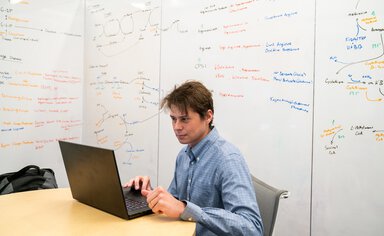
A man works at a laptop in a room where the walls are whiteboards covered in scribbles outlining cellular biology and pathways.
Cancer Patient Journeys + Colon Cancer
A future physician faces cancer
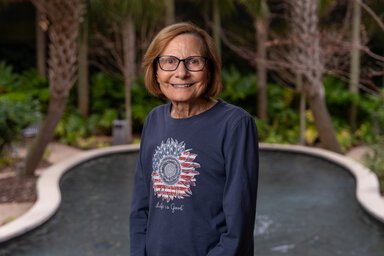
A woman poses in a garden setting.
Cancer Patient Journeys + Cancer Survivorship
Healing after head and neck cancer
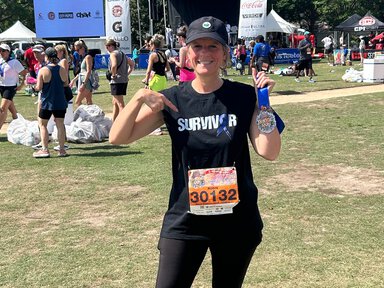
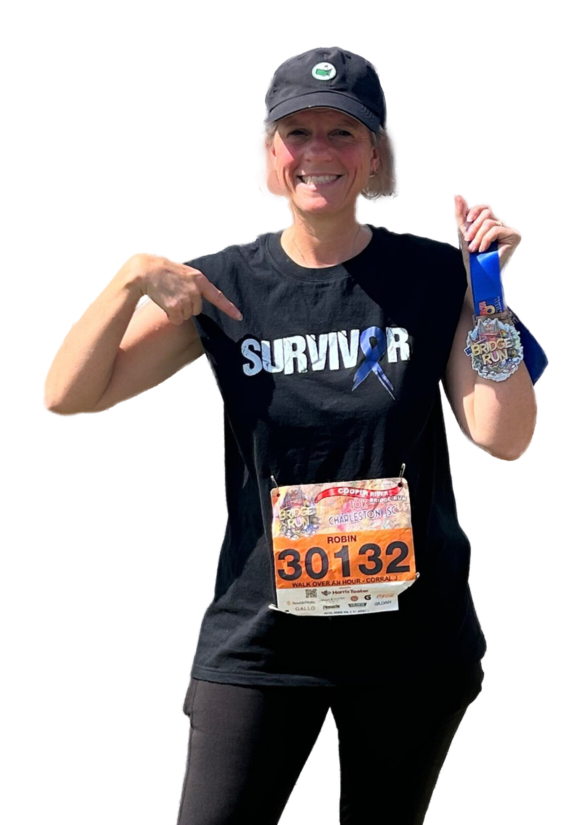
a woman holds up a 10K medal and points to the word 'survivor' on her T-shirt
Colon Cancer + Cancer Care
The power of screening: A cancer survivor’s remarkable journey
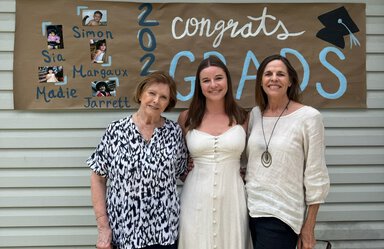
three generations of women in front of a congratulatory graduation sign
Cancer Prevention + Hereditary Cancer
How genetic counseling helped a family face cancer together
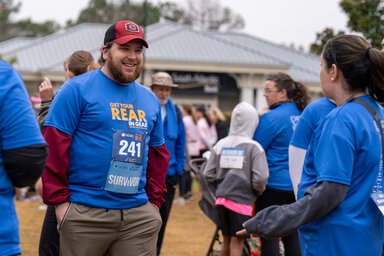
people in race t-shirts mingle after a community 5K fundraising event
Colon Cancer + Patient Journeys
‘If there’s a will, there’s a way’: A patient’s journey through colorectal cancer
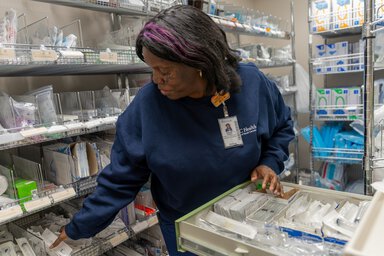
More than six years after treatment for colorectal cancer, Roberta Gibson continues work as a patient care technician at MUSC.
Colon Cancer + Cancer Care
Seeing care from the other side
After cancer, Luke experienced a typical childhood milestone - meeting his new baby sister in the hospital.
Cancer Care + Childrens Health
Fighting strong: A little warrior’s battle with a rare cancer
an abdominal scan
Cancer Care + Patient Journeys
Staying in the game: A kidney cancer survivor's journey
A man poses beside a sunny window.
Hereditary Cancer + Prostate Cancer
How genetic testing helped one cancer survivor to better understand his health
A married couple pose together on a loveseat.
Cancer Survivorship + Head and Neck Cancer
Hollings Head and Neck Cancer Survivorship Clinic helps survivors thrive
A man poses in the captain's chair of a pontoon boat docked on a creek that winds between back yards.
Clinical Trials + Cancer Research
South Carolina strong: Fighting lung cancer through a clinical trial
A nurse in scrubs poses in an operating room.
Cancer Care + Patient Journeys
Neuroendocrine carcinoma patient balances work and treatment
A man poses in a garden setting.
Cancer Care + Cancer Patient Journeys
After rare CTCL diagnosis, Lowcountry man finds dedicated care team at Hollings Cancer Center
A woman wearing a surgical mask leans her head against her hand as she takes a selfie in an infusion space.
Cancer Giving + Cancer Care
A second chance: LOWVELO rider living with leukemia and bringing hope to the Charleston area, one...

The minute we walked into Hollings, we felt a sense of peace. Everybody was so caring and informative. They took the time to explain everything, and I finally felt heard.

Robin Via Spotlight